It appears that Callan over at NOVA Geoblog started this one. I like mountain climbing (although I am not a high pointer as you will see) but I thought I would play anyway. Here's the tallest points in each of the 50 United States, with Puerto Rico's and Washington, DC's highest points thrown in for good measure. Elevations are in feet above mean sea level. I've bolded the ones I have personally stood atop:
Cheaha Mt., Alabama 2,405'
Mt. McKinley (Denali), Alaska 20,320'
Humphreys Peak, Arizona 12,633'
Magazine Mt., Arkansas 2,753'
Mt. Whitney, California 14,494'
Mt. Elbert, Colorado 14,433' (I now have a mission)
Mt. Frissell, Connecticut 2,380'
Fort Reno, Washington, DC 429'
Ebright Azimuth, Delaware 448'
Britton Hill, Florida 345'
Brasstown Bald, Georgia 4,784'
Mauna Kea, Hawai'i 13,796'
Borah Peak, Idaho 12,662'
Charles Mound, Illinois, 1,235'
Hoosier Hill Point, Indiana 1,257'
Hawkeye Point, Iowa 1,670'
Mt. Sunflower, Kansas 4,039'
Black Mt., Kentucky 4,139'
Driskill Mt., Louisiana 535'
Mt. Katahdin, Maine 5,267'
Backbone Mt., Maryland 3,360'
Mt. Greylock, Massachusetts 3,487'
Mt. Arvon, Michigan 1,979'
Eagle Mt., Minnesota 2,301'
Woodall Mt., Mississippi 806'
Taum Sauk Mt., Missouri 1,772'
Granite Peak, Montana 12,799' (I hear this one is nasty)
Panorama Point, Nebraska 5,424'
Boundary Peak, Nevada 13,140'
Mt. Washington, New Hampshire 6,288'
High Point, New Jersey 1,803'
Wheeler Peak, New Mexico 13,161'
Mt. Marcy, New York 5,344'
Mt. Mitchell, North Carolina 6,684'
White Butte, North Dakota 3,506'
Campbell Hill, Ohio 1,549'
Black Mesa, Oklahoma 4,973'
Mt. Hood, Oregon 11,239'
Mt. Davis, Pennsylvania 3,213'
Cerro de Punta, Puerto Rico 4390'
Jerimoth Hill, Rhode Island 812'
Sassafras Mt., South Carolina 3,560'
Harney Peak, South Dakota 7,242'
Clingmans Dome, Tennessee 6,643'
Guadalupe Peak, Texas 8,749' (nope, but I have been on Emory Peak, the second highest)
Kings Peak, Utah 13,528' (must find)
Mt. Mansfield, Vermont 4,393'
Mt. Rogers, Virginia 5,729'
Mt Rainier, Washington 14,410'
Spruce Knob, West Virginia 4,861'
Timms Hill, Wisconsin 1,951'
Gannett Peak, Wyoming 13,804'
So my list is just sad lol. I have been up a 14er here in Colorado, and many high ones in Montana and Alaska, but I guess just not the highest ones. A good map and comprehensive list of these high points can be found at geology.com. Which ones have you visited?
© ReBecca K. Hunt-Foster
Showing posts with label mountains. Show all posts
Showing posts with label mountains. Show all posts
Thursday, February 5, 2009


Monday, June 9, 2008
Book reviews: the result of two weeks without internet
When I was in the field this past week (almost two) I had the chance to read (alot, more on that tomorrow). I had taken two new books with me, which I plowed through in less than 13 days. So I thought I would tell you a little bit about them in case you were interested.
 Swine Not?: A novel, by Jimmy Buffett
This is a cute story about a pig and her family. She lives in a fancy New York City hotel and is constantly being hid from the hotel cook who hates animals and wishes to cook her. The pig is one a mission to find her brother, and the story is told from the pig and one of the children in the family's point of view. The official summary is: "When Southern belle Ellie McBride moves her twins from Vertigo,Tennessee to New York City
I decided to read this book for the obvious reason - it is written my Jimmy Buffett, of whom which I am a loyal fan. It was no where near as long as his past books (256 pages, at least it felt shorter) and the chapters were very short. The story was easy to follow and almost reminded me of a young adults book (not that that is a bad thing, it was just an easy read), and was adapted, in part, from his friends true troubles of hiding her pet pig in a fancy NYC hotel. I am an animal lover, so I understand how the family in the book feels like it must go to great lengths to protect their hoofed family member. This book is an easy read for anyone, and would be a great story to read to kids, since the chapters are short, the tale is fun, and the characters are easy to relate with. It is not your typical Jimmy book however with drunk sailors/cowboys, tropical places, and lyric references dropped in random places. Still a good read however.
 Forget Me Not, by Jennifer Lowe-Anker
"In September 1999, climbing legend Alex Lowe lost his life in an avalanche on Tibet’s Shishapangma, leaving behind his wife Jennifer and three sons. In the months that followed this devastating tragedy, Jennifer and Alex’s climbing partner Conrad Anker, who survived the avalanche that killed Alex, found solace in each other and were married in 2001. Now, Jennifer Lowe-Anker’s new book Forget Me Not, A Memoir, offers a portrait of Alex Lowe through letters and expedition notes, spanning continents to tell the story of three people whose lives intertwine to a degree they could never have imagined." (link)
I devoured this book!! I really enjoyed it, and would recommend it to anyone. It was a nice read, and it surprisingly did not make me cry as much as I was afraid it would (Maria Coffey's Where the Mountain Cast Its Shadow made me pretty much cry through the entire book). Very interesting, touching story. I really enjoyed hearing about how she and Alex met, fell in love, all of the adventures they shared together, and how she handled her life while her husband was away doing what he loved while she continued to do what she loved (she is an accomplished artist). It was also fun to find some similarities between herself and I, on personal life experiences we have both had. It was sad knowing how he died and how hard it must have been for her to break the news to her children, that part really got to me, along with all of the other loss she has had to bear. Overall I think it shows just how strong of a woman Lowe-Anker is - how she lost her true love but was able to keep going forward and putting one foot in front of the other and was able to find love again. Great story, you should really check it out!
Here is an interview clip:
Whats next? Not sure. I have several books I would like to read: The Songlines, Three Cups of Tea: One Man's Mission to Promote Peace . . . One School at a Time, The Namesake, and Farewell, My Subaru: An Epic Adventure in Local Living. Not sure which one will come first....any other recommendations out there?
 Swine Not?: A novel, by Jimmy Buffett
This is a cute story about a pig and her family. She lives in a fancy New York City hotel and is constantly being hid from the hotel cook who hates animals and wishes to cook her. The pig is one a mission to find her brother, and the story is told from the pig and one of the children in the family's point of view. The official summary is: "When Southern belle Ellie McBride moves her twins from Vertigo,
I decided to read this book for the obvious reason - it is written my Jimmy Buffett, of whom which I am a loyal fan. It was no where near as long as his past books (256 pages, at least it felt shorter) and the chapters were very short. The story was easy to follow and almost reminded me of a young adults book (not that that is a bad thing, it was just an easy read), and was adapted, in part, from his friends true troubles of hiding her pet pig in a fancy NYC hotel. I am an animal lover, so I understand how the family in the book feels like it must go to great lengths to protect their hoofed family member. This book is an easy read for anyone, and would be a great story to read to kids, since the chapters are short, the tale is fun, and the characters are easy to relate with. It is not your typical Jimmy book however with drunk sailors/cowboys, tropical places, and lyric references dropped in random places. Still a good read however.
 Forget Me Not, by Jennifer Lowe-Anker
"In September 1999, climbing legend Alex Lowe lost his life in an avalanche on Tibet’s Shishapangma, leaving behind his wife Jennifer and three sons. In the months that followed this devastating tragedy, Jennifer and Alex’s climbing partner Conrad Anker, who survived the avalanche that killed Alex, found solace in each other and were married in 2001. Now, Jennifer Lowe-Anker’s new book Forget Me Not, A Memoir, offers a portrait of Alex Lowe through letters and expedition notes, spanning continents to tell the story of three people whose lives intertwine to a degree they could never have imagined." (link)
I devoured this book!! I really enjoyed it, and would recommend it to anyone. It was a nice read, and it surprisingly did not make me cry as much as I was afraid it would (Maria Coffey's Where the Mountain Cast Its Shadow made me pretty much cry through the entire book). Very interesting, touching story. I really enjoyed hearing about how she and Alex met, fell in love, all of the adventures they shared together, and how she handled her life while her husband was away doing what he loved while she continued to do what she loved (she is an accomplished artist). It was also fun to find some similarities between herself and I, on personal life experiences we have both had. It was sad knowing how he died and how hard it must have been for her to break the news to her children, that part really got to me, along with all of the other loss she has had to bear. Overall I think it shows just how strong of a woman Lowe-Anker is - how she lost her true love but was able to keep going forward and putting one foot in front of the other and was able to find love again. Great story, you should really check it out!
Here is an interview clip:
Whats next? Not sure. I have several books I would like to read: The Songlines, Three Cups of Tea: One Man's Mission to Promote Peace . . . One School at a Time, The Namesake, and Farewell, My Subaru: An Epic Adventure in Local Living. Not sure which one will come first....any other recommendations out there?
Monday, May 12, 2008
Storm Over Everest
Be sure to check out the new David Breashears documentary "Storm Over Everest" tonight on PBS (9 to 11 P.M. ET; check your local listings for times). I am an Everest, and general mountain climbing junky, so I really love to see these types of documentaries with shots of these awesome mountains. Its just unfortunate that this particular story has so many sad things in it, which have been the topic of numerous books (Into Thin Air: A Personal Account of the Mt. Everest Disaster , Left for Dead: My Journey Home from Everest, Touching My Fathers Soul, High Exposure, The Climb: Tragic Ambitions on Everest, The Other Side of Everest: Climbing the North Face Through the Killer Storm, Ultimate High: My Everest Odyssey, Climbing High: A Woman's Account of Surviving the Everest Tragedy, Doctor on Everest: Emergency Medicine at the Top of the World - A Personal Account of the 1996 Disaster, Everest : Mountain Without Mercy...). On May 11, 1996 8 people lost their lives on Everest. This is still regarded as the most deadly year on Everest ever (15 died in total trying to reach the summit that year).
From the press release:
From the press release:
"Everybody always says that the definition of character is what you do when nobody is looking. And when we were up there, we didn't think anybody was looking. And so everybody did pretty much what the inner person, the real them, the exposed them would do.... I got to witness those acts--the good ones, the bad ones. And the individuals that came through, that did well, that were selfless. ... Every one of them to me is a hero...."
- Beck Weathers, storm survivor and author, "Left for Dead"
In May 1996, the world-renowned climber and filmmaker David Breashears was making his third ascent up Mount Everest, leading an IMAX film team, when a swift and ferocious storm unexpectedly hit the mountain, trapping three exhausted climbing teams near the top of the world's highest peak.
In the FRONTLINE special presentation Storm Over Everest, airing Tuesday, May 13, 2008, from 9 to 11 P.M. ET on PBS (check local listings), Breashears returns to summit Everest and to reflect on that fateful storm that resulted in the deaths of five climbers on the south side of the mountain. Combining breathtaking original cinematography with dramatic recreations of the storm conditions of May 1996, the two-hour, high-definition documentary transports viewers to the slopes of Mount Everest. Interviews with climbers who survived the harrowing ordeal recount the events that occurred--and the decisions that were made--that resulted in seasoned mountaineers losing their lives alongside less experienced climbers drawn to the mystique of Mount Everest.
"The mountain doesn't care whether we're here or not," Breashears says in the film. "Everything it means to us is only what we bring to it. It's what the mountain reveals about us that has any lasting value."
In Storm Over Everest, survivors recount the progress of three separate expeditions up the South Col of Mount Everest--and the near-intoxication some climbers felt as they approached the prized summit on May 10, 1996. "You've gone so far up the mountain, you've come so far from home, and you spent six months preparing for this goal," climber Charlotte Fox says. "There's no way you're going to turn around unless things are really going south."
Go south they did, and quickly. As victorious climbers celebrated on the summit and waited--perhaps too long--for the rest of their parties, an intense storm roared across Mount Everest, transforming what had been a beautiful day of mountain climbing into the ultimate struggle for survival. "Within the space of five minutes, it changed from really a good day with a little bit of wind to desperate conditions, something I'd never experienced the ferocity of before," climber John Taske says.
The expeditions began a frantic descent toward the safety of camp, even as their two experienced guides remained high on the mountain assisting other climbers. Hurricane-strength winds reached 80 miles an hour, and temperatures plummeted to 30 below zero. Then darkness fell. The climbers found themselves hopelessly lost in an unrelenting blizzard--blinded by the wind-blasted ice and unable to find their way back to high camp. "People who have all run out of oxygen, some of them really start collapsing, and those of us who are still able to walk try and pick them up, make them keep walking," recalls climber Lene Gammelgaard. "This is survival."
Storm Over Everest recounts the next pivotal 48 hours, when those in the wind-battered tents wrestled with whether to risk additional lives by attempting to rescue the missing climbers. Taske reflects on a life-or-death decision made in the chaos of the storm--ultimately to leave two climbers where they lay, frozen and barely conscious, one of whom had gone blind. "The decision to leave [them] where they were was not really a difficult decision...," he says. "Here were these other people exposed to phenomenal winds, at least 80 miles an hour, 20, 30 below zero at night. We thought it was kinder to leave them rather than cause them pain, even in a semiconscious state, by dragging them over to where we were. They were basically dead."
In the end, some climbers would miraculously find their way back to camp. Others would be rescued by the heroic efforts of those who risked their own lives by venturing out in the storm to lead them to safety. Five climbers--two of them expedition leaders--would not return."
Thursday, May 8, 2008
Books part 2: What I am currently reading
Here is what I am currently reading. I have only been reading journal articles lately, as far as paleo things go, so I decided it was time to read an actual book, since I have a backlog of those. I am also reading a new mountain climbing book, which has been really interesting. I typically try to limit myself to no more than two books at a time, just to keep the confusion down.
Bonebeds: Genesis, Analysis, and Paleobiological Significance
by Raymond R. Rogers (Editor), David A. Eberth (Editor), Anthony R. Fiorillo (Editor)
Synopsis: The vertebrate fossil record extends back more than 500 million years, and bonebeds—localized concentrations of the skeletal remains of vertebrate animals—help unlock the secrets of this long history. Often spectacularly preserved, bonebeds—both modern and ancient—can reveal more about life histories, ecological associations, and preservation patterns than any single skeleton or bone. For this reason, bonebeds are frequently studied by paleobiologists, geologists, and archeologists seeking to piece together the vertebrate record. Thirteen respected researchers combine their experiences in Bonebeds, providing readers with workable definitions, theoretical frameworks, and a compendium of modern techniques in bonebed data collection and analysis. By addressing the historical, theoretical, and practical aspects of bonebed research, this edited volume—the first of its kind—provides the background and methods that students and professionals need to explore and understand these fantastic records of ancient life and death.
So far I am really enjoying this book. The book is very well laid out, easy to read and very informative. I have seen many things in it that I plan to work into a project this summer! I was disappointed to find that the supplemental material does not appear to be available on the University of Chicago Press website anymore however (which I brought to the attention of one of the editors, hopefully this will be fixed). And there are a few papers that are not included in the Bonebed Database in the middle of the book (which, other than those absences, is wonderful to have in one place). Has anyone else read this one yet (Brian, weren't you making it through this one)?
No Shortcuts to the Top: Climbing the World's 14 Highest Peaks
by Ed Viesturs, with David Roberts
Synopsis: For eighteen years Ed Viesturs pursued climbing’s holy grail: to stand atop the world’s fourteen 8,000-meter peaks, without the aid of bottled oxygen. But No Shortcuts to the Top is as much about the man who would become the first American to achieve that goal as it is about his stunning quest. As Viesturs recounts the stories of his most harrowing climbs, he reveals a man torn between the flat, safe world he and his loved ones share and the majestic and deadly places where only he can go. A preternaturally cautious climber who once turned back 300 feet from the top of Everest but who would not shrink from a peak (Annapurna) known to claim the life of one climber for every two who reached its summit, Viesturs lives by an unyielding motto, “Reaching the summit is optional. Getting down is mandatory.” It is with this philosophy that he vividly describes fatal errors in judgment made by his fellow climbers as well as a few of his own close calls and gallant rescues. And, for the first time, he details his own pivotal and heroic role in the 1996 Everest disaster made famous in Jon Krakauer's Into Thin Air. In addition to the raw excitement of Viesturs’s odyssey, No Shortcuts to the Top is leavened with many funny moments revealing the camaraderie between climbers. It is more than the first full account of one of the staggering accomplishments of our time; it is a portrait of a brave and devoted family man and his beliefs that shaped this most perilous and magnificent pursuit.
I am sort of a armchair mountain climbing junkie. I even climbed my first peak over 14,000 feet this past summer!! I was thrilled to read that Viesturs climbs like me - he takes his time, looks for land marks, and just plods forward (made me feel less freak-like). He is not to proud to say he can't go any further if that is the case (not that is has happened to often in the book so far). I love his mantra “Reaching the summit is optional. Getting down is mandatory.” Of course, that is where the differences between us ends, since if I tried to climb up a 8,000 meter peak my lungs would leap from my chest and never return. Heck, I would probably be hurting at Everest basecamp (even though I would still like to visit it). My ultimate weight loss plan is to just go hang out at Denali basecamp to loose 20 lbs in a month. That would be a fun reality show. But I regress.....Ed's book is very interesting. Its fun to read about a guy from Rockford, Illinois who was the first American to bag all of the 8,000 meter peaks. He has his share of sad stories and made me tear up at least once so far. This is the kind of book I love to read. He can take me away to these far away places and do things that I can only dream about, but his stories and words are so vivid that you feel like you are there with him. I am really enjoying this book so far. It give me something to look forward to everyday and make me look forward to climbing my next 14,000 foot peak (which is pretty hard for me)!
All images are from Barnes & Noble.com.
Bonebeds: Genesis, Analysis, and Paleobiological Significance

by Raymond R. Rogers (Editor), David A. Eberth (Editor), Anthony R. Fiorillo (Editor)
Synopsis: The vertebrate fossil record extends back more than 500 million years, and bonebeds—localized concentrations of the skeletal remains of vertebrate animals—help unlock the secrets of this long history. Often spectacularly preserved, bonebeds—both modern and ancient—can reveal more about life histories, ecological associations, and preservation patterns than any single skeleton or bone. For this reason, bonebeds are frequently studied by paleobiologists, geologists, and archeologists seeking to piece together the vertebrate record. Thirteen respected researchers combine their experiences in Bonebeds, providing readers with workable definitions, theoretical frameworks, and a compendium of modern techniques in bonebed data collection and analysis. By addressing the historical, theoretical, and practical aspects of bonebed research, this edited volume—the first of its kind—provides the background and methods that students and professionals need to explore and understand these fantastic records of ancient life and death.
So far I am really enjoying this book. The book is very well laid out, easy to read and very informative. I have seen many things in it that I plan to work into a project this summer! I was disappointed to find that the supplemental material does not appear to be available on the University of Chicago Press website anymore however (which I brought to the attention of one of the editors, hopefully this will be fixed). And there are a few papers that are not included in the Bonebed Database in the middle of the book (which, other than those absences, is wonderful to have in one place). Has anyone else read this one yet (Brian, weren't you making it through this one)?
No Shortcuts to the Top: Climbing the World's 14 Highest Peaks
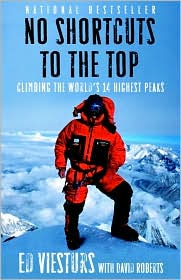
by Ed Viesturs, with David Roberts
Synopsis: For eighteen years Ed Viesturs pursued climbing’s holy grail: to stand atop the world’s fourteen 8,000-meter peaks, without the aid of bottled oxygen. But No Shortcuts to the Top is as much about the man who would become the first American to achieve that goal as it is about his stunning quest. As Viesturs recounts the stories of his most harrowing climbs, he reveals a man torn between the flat, safe world he and his loved ones share and the majestic and deadly places where only he can go. A preternaturally cautious climber who once turned back 300 feet from the top of Everest but who would not shrink from a peak (Annapurna) known to claim the life of one climber for every two who reached its summit, Viesturs lives by an unyielding motto, “Reaching the summit is optional. Getting down is mandatory.” It is with this philosophy that he vividly describes fatal errors in judgment made by his fellow climbers as well as a few of his own close calls and gallant rescues. And, for the first time, he details his own pivotal and heroic role in the 1996 Everest disaster made famous in Jon Krakauer's Into Thin Air. In addition to the raw excitement of Viesturs’s odyssey, No Shortcuts to the Top is leavened with many funny moments revealing the camaraderie between climbers. It is more than the first full account of one of the staggering accomplishments of our time; it is a portrait of a brave and devoted family man and his beliefs that shaped this most perilous and magnificent pursuit.
I am sort of a armchair mountain climbing junkie. I even climbed my first peak over 14,000 feet this past summer!! I was thrilled to read that Viesturs climbs like me - he takes his time, looks for land marks, and just plods forward (made me feel less freak-like). He is not to proud to say he can't go any further if that is the case (not that is has happened to often in the book so far). I love his mantra “Reaching the summit is optional. Getting down is mandatory.” Of course, that is where the differences between us ends, since if I tried to climb up a 8,000 meter peak my lungs would leap from my chest and never return. Heck, I would probably be hurting at Everest basecamp (even though I would still like to visit it). My ultimate weight loss plan is to just go hang out at Denali basecamp to loose 20 lbs in a month. That would be a fun reality show. But I regress.....Ed's book is very interesting. Its fun to read about a guy from Rockford, Illinois who was the first American to bag all of the 8,000 meter peaks. He has his share of sad stories and made me tear up at least once so far. This is the kind of book I love to read. He can take me away to these far away places and do things that I can only dream about, but his stories and words are so vivid that you feel like you are there with him. I am really enjoying this book so far. It give me something to look forward to everyday and make me look forward to climbing my next 14,000 foot peak (which is pretty hard for me)!
All images are from Barnes & Noble.com.
Subscribe to:
Posts (Atom)