Showing posts with label fossils. Show all posts

Wednesday, May 12, 2010

Hand lens + cell phone vs. DinoLight

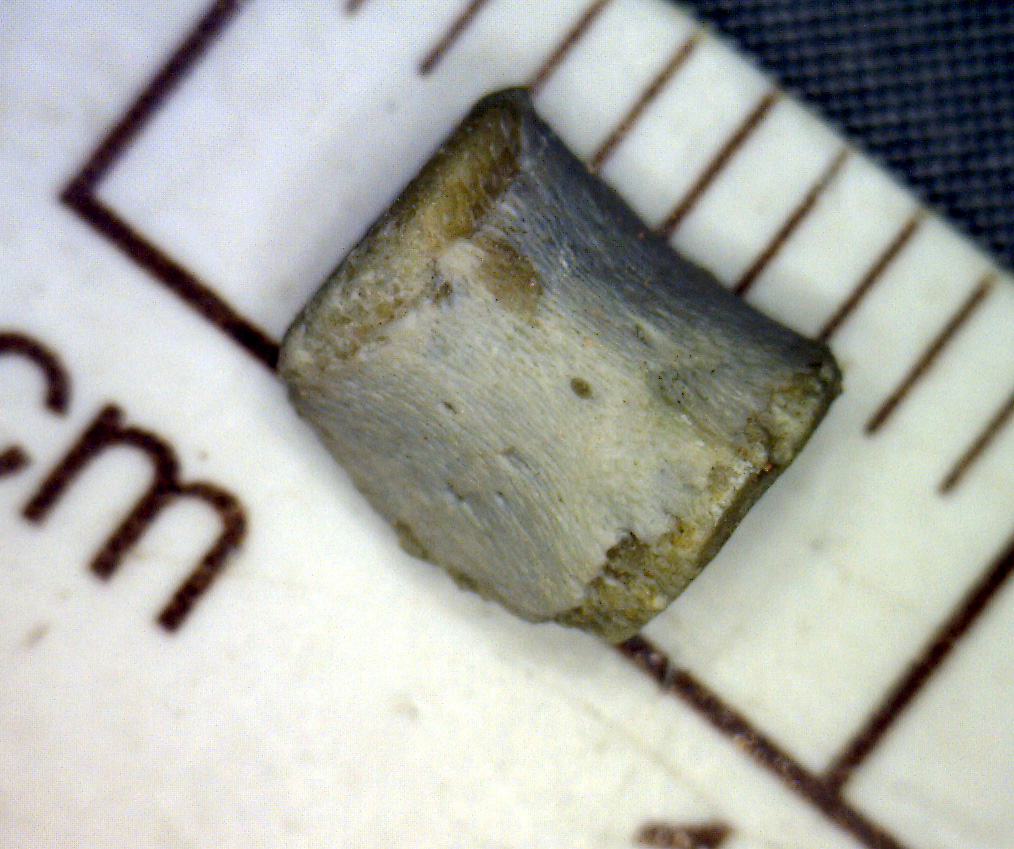
Callan Bentley recently introduced many of us to the idea of using your cell phone with a hand lens to get macro images (he saw this on at Microecos and Myrmecos). Callan and Chris used a iPhone, which I sadly still do not have. Silver Fox tried a 2MP HTC 6800 phone. I have an LG enV, so I tried that. Below are the results with my phone + 1 hand lens.

Dryosaurus caudal vertebra (ventral view), taken with an LG enV phone and a hand lens.
I was pretty happy with the outcome.

I decided to try to take a picture of the same vert with our new "DinoLight" [here is a review of the camera]. John recently purchased this to try an get some better macro pictures of his trilobites than we were getting with our default camera. Below is the same vert, taken with the scope camera:

Dryosaurus caudal vertebra (ventral view), taken with the "DinoLight"


Not too surprising, the scope camera worked somewhat better. It can be a tad on the touchy side when focusing, but over all it is pretty easy to use. I just wish the resolution was a little better. It is also nice to know that your phone and the hand lens will work in a pinch.

Just for fun, here is another fossil that happened to be in reach... under the DinoLight:
Tiny mammal jaw (Morrison Formation, upper Jurassic of Wyoming) mounted on pin head.


© ReBecca K. Hunt-Foster

Tuesday, July 14, 2009

Concretionary fun

There was a recent article in the Colorado Springs Gazette about fellow paleoblogger Anthony and his adventures in concretion land. As anyone who has ever had the pleasure of identifying fossils for the public we all know for every real fossil someone brings in you usually get a barrel full of concretions that people also brought in. I have found that having separate concretion and fossil examples that you can show to the public helps them to understand what they have and why it is not a dinosaur egg/heart/eye, fish, plesiosaur paddle, turtle, ect......sometimes it is an easy mistake to make, especially when you do not see fossils on a daily basis. Some of these concretions can be pretty cool looking and are interesting rocks/minerals on their own (without needing to pretend to be a fossil). And there are usually some pretty interesting storied that accompany most concretions.

I thought I would share some of the fun items we have in our lab that have been brought in and donated over the years:

Not sure what someone thought this one could be.

A variety of "eggs and/or turtles"


"Its a ceratopsian horn!" - No, its not. Sadly.

And this one is not a concretion, but I threw it in to see if anyone is paying attention. Any guesses on what it is (and there are at least two people out there who better know this):


© ReBecca K. Hunt-Foster

Tuesday, April 7, 2009

...more fossils just waiting to be discovered

This is the fourth article in a monthly series featured in the Vernal Express celebrating 100 Years of Discovery at Dinosaur National Monument, written by Dinosaur National Monument Park Guide Matthew Greuel. You can read his other articles on the Vernal Express website [my previous blog link1, 23]. 

This is probably one of my favorite sections Matt has written thus far. It talks about the building of the Quarry Visitor Center, about the first park paleontologist (Dr. Theodore White) and about the numerous people who worked very hard in the beginning to expose the fossil you use to be able to see in the quarry wall.

There’s more, waiting to be discovered
by Matthew Greuel (March.09)

"Such was the view of some influential people toward the Carnegie Quarry at Dinosaur National Monument in 1925. The Carnegie Museum of Natural History, the University of Utah, and the United States National Museum had come and gone. Why should any further development occur?

Certain other people, however, felt differently.

Paleontologist Earl Douglass felt very strongly that there were more fossils just waiting to be discovered. University of Utah geology professor Dr. Frederick Pack agreed, to the point that he sent a letter to the National Park Service (NPS) requesting no further excavation permits be granted “…until a decision has been reached as to what can be done during the next two or three years in excising a dinosaur deposit in permanent relief under proper protection...” The movement to enclose the Carnegie Quarry fossil wall in a building for public benefit started some years earlier when the public and paleontologists alike began to understand the magnitude of the dinosaur graveyard at the quarry site. Douglass himself broached the idea with Carnegie Museum officials prior to the creation of Dinosaur National Monument. Civic organizations in Vernal, the Uintah Basin, and Salt Lake City kept pressure on elected officials, including Utah Congressman Don Colton. Congressman Colton introduced separate bills to build on the quarry, but they never left committee. Some museums, including the Smithsonian, inquired about building and operating a site at the quarry.

The refrain from all these groups, however, was the same: The desire and demand was there, but the financial and other resources were not.

A steady stream of tourists visited the monument through the 1930s, hosted by Acting Custodian Dr. A.C. Boyle and his various New Deal-era crews. The onset of World War II, however, pulled resources and attention away from the monument.

The post-WWII era saw most federal government budgets increased back to pre-WWII levels, or even higher…except the National Park Service. Americans, with newfound freedom, mobility, and a desire for The Wild West, sought out National Parks in record numbers. It quickly became apparent that the minimal services offered by most parks were woefully inadequate, and Dinosaur National Monument was no exception. National Park Service Director Conrad Wirth thus proposed Mission 66: an ambitious project to build and upgrade visitor centers, roads, employee housing, and other necessities by 1966, the 50th anniversary of the NPS. The time and energy already spent discussing and estimating the visitor center at the Carnegie Quarry meant that building would be one of the first, and one of the most prominent, Mission 66 projects...."

Keep reading the article here.

Original article © Vernal Express.

Monday, February 23, 2009

Earl and Apatosaurs louisae

This is the third article in a monthly series featured in the Vernal Express celebrating 100 Years of Discovery at Dinosaur National Monument, written by Dinosaur National Monument Park Guide Matthew Greuel. You can read his first article here, and the second article here, both on the Vernal Express website [my previous blog link1, 2].

It was a beautiful sight
by Matthew Greuel (02.11.09)

"At last, in the top of the ledge where the softer overlying beds form a divide, a kind of saddle, I saw eight of the tail bones of a brontosaurus in exact position. It was a beautiful sight.”

Earl Douglass wrote this in his diary on Aug. 17, 1909. Earlier that day he laid eyes on eight tail vertebrae of what was popularly known as Brontosaurus but today is known as Apatosaurus. He had found the dinosaur so dearly desired. The entire fossil animal totaled 76 feet long and 15 feet tall when reconstructed. This specimen was so complete that it is the type specimen of Apatosaurs louisae – the specimen against which all other Apatosaurs louisae are compared. It was named after Andrew Carnegie’s wife, Louise.

Removing this first dinosaur proved time consuming, but efficiency improved as Douglass and the crew became more familiar with their tasks. Douglass would remark that “…during the last ten months we have taken out much more than during the previous twenty months.” Part of this increase in efficiency was the mapping of the quarry face. Douglass would paint a grid-lines on the rock [see picture], then draw the locations of fossils a scale model grid on paper. Each fossil had an alpha-numeric code written on it. This system, still in use today, made it possible for the dinosaurs to be reconstructed upon arrival at the Carnegie Museum in Pittsburgh, Pennsylvania.

There was barely a road to the new fossil quarry for transporting the bones, let alone for visitors to travel for a glance at the work being performed. Douglass and the crew, however, welcomed around 400 visitors annually the first few years of work. Douglass wrote of the visitors the first Sunday after discovery, “Today two loads of people came from Vernal to see the Dinosaur and there were several loads from other places…For a time the rocks that never had the impress of a woman’s foot and seldom that of a man swarmed with people of all ages. Mothers and grandmothers ascended the steep, almost dangerous slopes, with babes and there were men and women well along in years…” The power of dinosaurs to capture the imagination of scientist and non-scientist alike was on display....."

Keep reading the article here.

Original article © Vernal Express; photo of Earl Douglass © the Special Collections department of the University of Utah, Marriott Library Earl Douglass Photography Collection.

Thursday, February 19, 2009

What is a Paleontologist?

This is the second in a monthly series of articles in the Vernal Express celebrating 100 Years of Discovery at Dinosaur National Monument, written by Dinosaur National Monument Park Guide Matthew Greuel. You can read his first article here, on the Vernal Express website [my previous blog link]. Look for the third article coming soon.

So, what is a Paleontologist?

by Matthew Greuel (01.28.09)

"Start talking paleontology, dinosaurs and other fossils, and often certain images pop up: men in laughably clean khakis and pith helmets removing bones with paintbrushes at digs in remote and exotic desert locations.

Jim Jensen with Supersaurus scapulocoracoid (Jensen 1985). Khakis? Pith helmet? Paintbrush? Remote/exotic location? Depends on your definition of Colorado. I give a partial check.

Scientists tell us that a paleontologist is someone who studies fossils, the remains of long-dead animals.

The Society of Vertebrate Paleontology defines a paleontologist as “a person who studies fossils … Fossils are any naturally occurring objects that tell us about ancient life. They can be bones, teeth, shells, leaf impressions, footprints, insects trapped in amber, or any number of other sorts of things.”

However, what does it really mean to be a paleontologist?

Paleontology, like many other sciences, is a combination of skills and disciplines. Geology, chemistry, biology, botany, math and engineering are among the dominant disciplines.

Fossils are a large and very important chapter in the history of Earth, telling us about different environments and changes that have occurred. Paleontologists use these disciplines to help read fossils and ancient landscapes – read the stories and information they hold, and interpret them and what they mean.

One of, if not the most well known fossil that paleontologists study are dinosaurs. Dinosaurs can be considered a gateway fossil: They have unparalleled power to capture imaginations, especially the imaginations of children, and lead to interest in and study of other sciences.

Think back to when you were young – did dinosaurs not evoke some kind of response? Totally change what you thought is possible in the world? Maybe give you a nightmare or two?..."

Keep reading here.


Original article © Vernal Express; photo1 from SVPOW and Jensen, James A. 1985. Three new sauropod dinosaurs from the Upper Jurassic of Colorado. Great Basin Naturalist 45 (4): 697-709; photo2 from Apropos of Something.

Saturday, January 24, 2009

Hunting Fossils in the Uinta Basin proves interesting

The first in a monthly series of articles celebrating 100 Years of Discovery at Dinosaur National Monument was published last week by Dinosaur National Monument Park Guide Matthew Greuel. Keep an eye out on the Vernal Express for future articles.

Hunting Fossils in the Uinta Basin proves interesting

"Earl Douglass came to the Uinta Basin not to study dinosaurs but fossil mammals. He found much more than that, both paleontologically and otherwise.

Earl Douglass’ path to the Uinta Basin is not unlike many people today: The more he studied his trade, the science of studying fossils called paleontology, the more he knew there were fantastic opportunities for his line of work. His years of researching, studying and collecting in fossil beds in Wyoming and Western Montana in the late 1800s earned him praise in the field of paleontology, but he continued to toil in relative obscurity in the eyes of the public. He focused his research on fossil mammals – camels, three-toed horses, rhinoceroses, mastodons and others. He added 17 genera and 83 species to the scientific record of fossil vertebrates before coming to the basin.

His financial prospects during most of his life were tenuous at best, like many people today. Paleontology was not a high-paying profession then, nor is it today. Douglass was working during the summer, researching and digging and building his collections, but his lack of income was a constant source of stress. He worked as a schoolteacher at various schools during the winters, saving as much money as possible. The pressures and stresses, however, never took away from the main goal: to keep studying fossils, to keep adding to the scientific record, to keep working for greater scientific understanding. Fossil hunting and the science learned were tools he used to arouse interest and fascination with nature and help further understanding of Earth. He summarized this thought when he wrote, “Science is valuable in proportion as it is taken into the consciousness of the people.” He wrote at a different time, “The view we are now getting of the past by discovery of fossil animals and plants make the present world ever new to us giving to everything a wider interest and a greater significance. Every little untouched spot of nature, every tree, every plant suggests new ideas and is a little incentive for the world of the imagination.......”

Keep reading the article here.

Photos of Earl Douglass can be found in the Special Collections department of the University of Utah, Marriott Library Earl Douglass Photography Collection.