Monday, August 23, 2010

Politics and Paleo

As members of the VertPaleo listserv may have recently noticed (or noticed for years now), politics and paleontology often don't go together. You can never make anyone in a group happy when you talk about politics to start off with, and it is generally wise to just keep your thoughts to yourself.

Politics recently entered the realm of paleontology again, this time to bitch about sending students on a trip to China. And, no suprise, it involved two of my "favorite" guys: Arizona Senator John McCain and Senator Tom Coburn of Oklahoma. You may remember our old friend Coburn who was a pain in the ass about PRPA. I guess these two guys (or thier interns and staff most likely) got together and put together a list of "100 stimulus projects that give taxpayers the blues." [pdf link to report]

The 76th item on their list was a NSF funded trip for Montana State students to travel to China to study dinosaur eggs. Which they did. And sure, while they were over there, they saw things other than dinosaur eggs. So whats the big deal?  Its not like the school was spending the NSF money on extra trips to sight-see. But isn't it in the best interest of students visiting another country to experience all that country has to offer?

From the report:

Field Trip to Study Dinosaur Eggs…in China (Bozeman, MT) - $141,002463
This past spring, nine students from Montana State University (MSU) were given a six-week, all expense paid trip to China, funded by the National Science Foundation.464 MSU received a grant to send students to work with researchers at the Natural History Museum in Hangzhou studying various dinosaur eggs and other fossils.465 In a conversation with a local resident of Wuzhen, one of the students said “I told him that I was here to study dinosaur eggs. He replied with, ’Bloody hell! That’s the sort of thing you just can’t make up!’” While there, the students spent six weeks examining and cataloguing the eggs. As recorded on the group’s blog, however, they were still able to take plenty of time to let their hair down hiking on the Great Wall, spending a day at the Xixi National Wetland Park, exploring several small towns, visiting the opera, and touring the Tiatai temples. Not to worry though, according to one student blogger, “Believe it or not from previous blog posts, we have been hard at work doing research.” [page 39-40 of report]
Once again, politicians making a big deal out of nothing.

© ReBecca K. Hunt-Foster

Friday, July 23, 2010

Fieldwork Friday #12

Yikes! I have not done a Fieldwork Friday in a year! Something is just wrong with that!! I have been pretty busy at work recently. I am running the Mygatt-Moore Quarry in western Colorado this summer. I had been intending on doing some Fieldwork Friday post now that I have been out in the field, but have never gotten around to it. Sorry about the lack of post recently. There is a lot going on in my life at the moment that keeps me from blogging. So I thought I would give you a quick update on one of the more interesting find we have had at the quarry recently.

Tibia with dig participant for scale
A week ago this past Thursday we successfully removed a large sauropod tibia from the quarry. This is most likely from Apatosaurus, or possibly Diplodocus (but we are pretty sure at this point it’s Apato). It was initially discovered by one of our museum’s volunteers, Tom S., on July 1st as we worked the quarry. We worked hard to get it out of the ground on July 8th. Luckily for us this bone was relatively easy to excavate! It was 1100 mm long and nice and straight. We commonly get sauropod vertebra at the quarry (too many in my opinion lol), so it was nice to find something easy to excavate for once. Those freaking verts can take way to long to get out (sorry, I could rant on verts all day). The last time we removed a sauropod limb bone from the quarry in 2007 – a nice Apatosaurus fibula. It only took 8 trip participants, museum volunteers, and employees to drag the tibia on a tarp the short distance from its former 150 million year old resting place to the awaiting truck for its trip back to the museum prep lab.

Tibia encased in the field jacket and ready to be flipped

The down side of the tibia

Tom and his great find! 
It would be nice if we could get several more limb bones this summer. So far it has been dominated by sauropod verts, ribs, plenty of float and quite a few Diplodocus, Apatosaurus and Allosaurus teeth. My dream is to finally get a Mymoorapelta femur from this quarry. Fingers crossed.

Two of the teeth collected this summer


If anything else of interest pop’s up this summer I will be sure to post something about it. If you are going to be in western Colorado this summer be sure to pull off on exit 2 of I-70 and say hello!

© ReBecca K. Hunt-Foster. Please see the "Field Work Friday Rules" about the work I do and collection practices.

Monday, July 19, 2010

Book Suggestion: The Second Jurassic Dinosaur Rush

My friend Paul Brinkman has a new book out that I encourage everyone to check out – The Second Jurassic Dinosaur Rush: Museums; Paleontology in America at the Turn of the Twentieth Century. It is available on Amazon.com from University of Chicago Press (preview here on Google Books). I have not had a chance to finish the book yet, but I am really enjoying reading it so far! It covers some of the local paleontology that took place in my area of western Colorado back in the early 1900’s when Elmer Riggs of the Chicago Field Museum was excavating the worlds first Brachiosaurus here in Grand Junction. He later also collected a partial Apatosaurus specimen from Dinosaur Hill in Fruita, just down the road from the museum where I work. The Brachiosaurus site is now on property owned by the museum (“Riggs Hill”) and is an island of Morrison Formation lost in a sea of subdivisions. I wonder if Riggs would still recognize the area today. The Dinosaur Hill area is still relatively undeveloped (especially compared to Riggs Hill) and the museum maintains a trail here that we co-manage with our local BLM office. Paul’s book is giving a great background on Riggs, along with work that took place post Marsh & Cope for big east coast museum. I suggest that anyone who is interested in paleo history check out this book, especially if you are curious about many of the immense, classic dinosaurs that you see on display in the old, big museums of the east. If I get a chance when I finish the book I will post a better review of its contents.


© ReBecca K. Hunt-Foster

Saturday, July 17, 2010

Movie Review: Creation

I FINALLY got to see Creation this week. It is available on Netflixs now. I never had a chance to see it when it was in theaters (it never showed anywhere near where I lived). I really enjoyed the movie and felt like the showed Darwin for the human that he was. I am sure there were some liberties Hollywood took for dramatic effect, but I thought it played well to convey the point. Darwin was a Christian that grappled with his observations in science and his faith, or lack there of after his daughter dies. Darwin has to deal with hypocrites and trouble makers, and his wife, who was a devout Unitarian, and her fear that they would never live together in heaven if he continued to pursue his thoughts on evolution. Huxley proclaimed that Darwin would finally be the man who is known for “killing God” which seems to freak Darwin out pretty bad (see the trailer below at about 65 seconds in). It was an interesting insight into Darwin’s home and family life. There are quite a bit of flashbacks to move the story along. My husband did not like this, but it did not bother me too much. In the end I thought it was well acted and an interesting story. I really do not understand why so many Christians would be afraid to see this film. Maybe they would be more understanding of the man behind the Origin of Species and stop being so afraid of what they really do not know. Darwin was just another human, not a demon for his thoughts on evolution.


© ReBecca K. Hunt-Foster
Wednesday, June 16, 2010

The First National Fossil Day!!

The National Park Service and the American Geological Institute are partnering to host the first National Fossil Day on October 13, 2010 during Earth Science Week. National Fossil Day is a celebration organized to promote public awareness and stewardship of fossils, as well as to foster a greater appreciation of their scientific and educational value.

This year’s Earth Science Week toolkit includes a “Fossils of the National Parks” poster, featuring a map showing more than 228 parks managed by the National Park Service that contain fossils. The poster also includes a “How to be a Paleontologist” classroom activity.


Fossils discovered on the nation’s public lands preserve ancient life from all major eras of Earth’s history, and from every major group of animal or plant. In the national parks, for example, fossils range from primitive algae found high in the mountains of Glacier National Park, Montana, to the remains of ice-age animals found in caves at Grand Canyon National Park, Arizona. Public lands provide visitors with opportunities to interpret a fossil’s ecological context by observing fossils in the same place those animals and plants lived millions of years ago.

National Fossil Day activities will also highlight fossil fuels to correlate with this year’s Earth Science Week theme, “Exploring Energy”.

National Fossil Day is being promoted through partnerships with professional organizations, government agencies, and other groups. Supporters include the Arizona Museum of Natural History, the Association of American State Geologists, the International Palaeontological Association, the Museum of Western Colorado, National Association of Geoscience Teachers, National Earth Science Teachers Association (NESTA), National Park Foundation, National Parks Conservation Association, Paleontological Research Institution (PRI), Utah Friends of Paleontology and Utah Geological Survey. Representatives from NESTA and PRI are also assisting with planning.

On October 13, paleontologists and park rangers will share fossil discoveries at special events nationwide and explain the importance of preserving fossils where they are found, so that everyone can share a sense of discovery!

To learn more, visit the National Fossil Day website or send a message to National_Fossil_Day@nps.gov. Join in the celebration of National Fossil Day today!

This blog post, and all post on Dinochick Blogs, are © ReBecca K. Hunt-Foster, unless otherwise stated

Wednesday, June 9, 2010

Stolen Content

I would like to point out that a blog called "The Lounge Forum.net" is stealing content from this blog, complete with my name and posting it on their blog. I have contacted the individual and have been ignored and have also contacted their server and have also still been ignored. I would like to point out that I am not affiliated with this blog nor do I know who owns it. I would love for them to knock it off and run their own damn blog and stop stealing my content.

Thanks to Callan for the heads up!

© ReBecca K. Hunt-Foster

Wednesday, May 26, 2010

Ajkaceratops

Ősi, A., Butler, R.J. & Weishampel, D.B. 2010. A Late Cretaceous ceratopsian dinosaur from Europe with Asian affinities. Nature 465: 466–468. doi: 10.1038/nature09019 [link]

"Figure 1: Anatomy of Ajkaceratops kozmai gen. et sp. nov." image from paper.
Ceratopsians (horned dinosaurs) represent a highly diverse and abundant radiation of non-avian dinosaurs known primarily from the Cretaceous period (65–145 million years ago). This radiation has been considered to be geographically limited to Asia and western North America with only controversial remains reported from other continents. Here we describe new ceratopsian cranial material from the Late Cretaceous of Iharkút, Hungary, from a coronosaurian ceratopsian, Ajkaceratops kozmai. Ajkaceratops is most similar to ‘bagaceratopsids’ such as Bagaceratops and Magnirostris, previously known only from Late Cretaceous east Asia. The new material unambiguously demonstrates that ceratopsians occupied Late Cretaceous Europe and, when considered with the recent discovery of possible leptoceratopsid teeth from Sweden, indicates that the clade may have reached Europe on at least two independent occasions. European Late Cretaceous dinosaur faunas have been characterized as consisting of a mix of endemic ‘relictual’ taxa and ‘Gondwanan’ taxa, with typical Asian and North American groups largely absent. Ajkaceratops demonstrates that this prevailing biogeographical hypothesis is overly simplified and requires reassessment. Iharkút was part of the western Tethyan archipelago, a tectonically complex series of island chains between Africa and Europe, and the occurrence of a coronosaurian ceratopsian in this locality may represent an early Late Cretaceous ‘island-hopping’ dispersal across the Tethys Ocean.


Thanks to TH for the heads up!

Wednesday, May 19, 2010

A new paleo blog!

There is a new paleo blog on the block - Jurassic Journeys by Dr. Matt Bonnan - who stopped by the museum today with some of his former and current students on their way to the Hanksville-Burpee quarry in Utah. It was nice to show them around our collections and have a chance to talk with everyone. Sounds like they are off to another great start at the HBQ. You can find out more about the dig in this video:


On a related note, we began opening the Mygatt-Moore Quarry today and will be back out in the field tomorrow (if we can get the rain to knock it off). Our first official day of work is a week from today! It will be here before we know it!

© ReBecca K. Hunt-Foster

Wednesday, May 12, 2010

Hand lens + cell phone vs. DinoLight

Callan Bentley recently introduced many of us to the idea of using your cell phone with a hand lens to get macro images (he saw this on at Microecos and Myrmecos). Callan and Chris used a iPhone, which I sadly still do not have. Silver Fox tried a 2MP HTC 6800 phone. I have an LG enV, so I tried that. Below are the results with my phone + 1 hand lens.

Dryosaurus caudal vertebra (ventral view), taken with an LG enV phone and a hand lens.
I was pretty happy with the outcome.

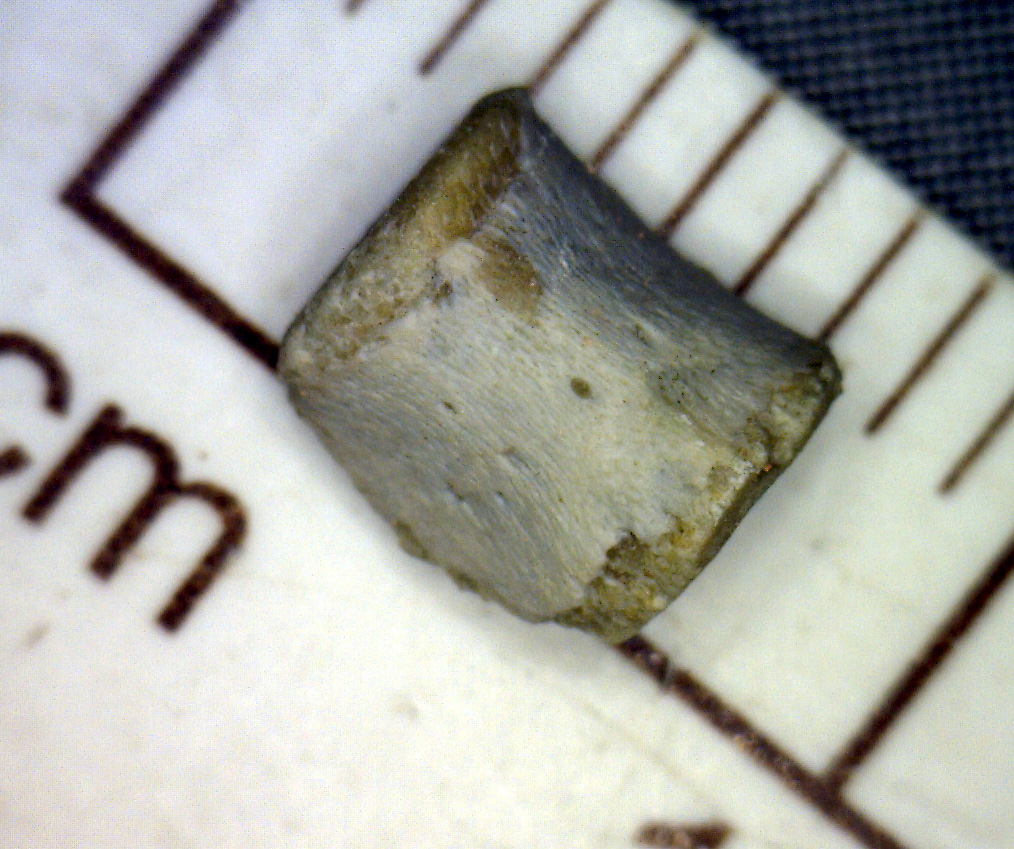
I decided to try to take a picture of the same vert with our new "DinoLight" [here is a review of the camera]. John recently purchased this to try an get some better macro pictures of his trilobites than we were getting with our default camera. Below is the same vert, taken with the scope camera:

Dryosaurus caudal vertebra (ventral view), taken with the "DinoLight"


Not too surprising, the scope camera worked somewhat better. It can be a tad on the touchy side when focusing, but over all it is pretty easy to use. I just wish the resolution was a little better. It is also nice to know that your phone and the hand lens will work in a pinch.

Just for fun, here is another fossil that happened to be in reach... under the DinoLight:
Tiny mammal jaw (Morrison Formation, upper Jurassic of Wyoming) mounted on pin head.


© ReBecca K. Hunt-Foster