"A proposed coal mining project by Westar Resources, Inc. on Ellesmere Island (Nunavut) in Canada's eastern High Arctic is currently under review by the Nunavut Impact Review Board (NIRB), an environmental assessment agency established under the Nunavut Land Claims Agreement whose objectives are to protect and promote the well-being of the residents, communities and ecosystems of Nunavut. The proposed development area includes fossil sites of a broad range of ages that include some of the most significant sites in the world, and the Society of Vertebrate Paleontology (SVP) is deeply concerned over the possible loss of these valuable resources...."
Continue reading here.
Thursday, January 14, 2010
Proposed Mining on Ellesmere Island
Please check out this link for important information regarding proposed mining on Ellesmere Island.


Tuesday, January 12, 2010
The Poetry of Charles H. Sternberg
I knew Charles H. Sternberg had written the books Life of a Fossil Hunter (1909) and Hunting Dinosaurs in the Bad Lands of the Red Deer River, Alberta, Canada (1917). I was unaware that he had written a book of poetry in 1911 - A story of the past or The romance of science. It is such a cool compilation of poems, really a must read. Hat tip to Andy for pointing it out, and for mentioning that it is available on Google Books - so go check it out (Life of a Fossil Hunter is also available)! Below if one of my favorite poems from the book.
IN THE LARAMIE
For many years my life work ply,
And many museums supply
With the rich store from Nature's book.
On many wondrous scenes I look.
I've often wanted to explore
The graveyard of the Dinosaur,
And when the British Museum said
They'd like to own a mighty head,
The largest of the saurians dread,
Triceratops (Marsh gave the name),
To Converse County then I came.
In Wyoming's range for sheep
Are many canyons carved quite deep,
In the grey sands and beds of clay;
While haystack buttes on every side,
That often crown some high divide.
The creeks spread out in fanlike shape,
That everywhere the surface break
Into ravines, with edges steep;
While here the dead for ages sleep.
For weeks we worked the Laramie,
Those beds of sand from fossils free.
Night after night my boys come in,
And not a single fossil win.
We search out Hatcher's chosen field,
That not a single skull will yield.
At last we reach the Cheyenne brakes,
Each one a rugged canyon takes
And follows it to cedar crest.
I work on steadily with the rest.
At last one day we moved our tent;
Across the roughest ground I went,
I came to a denuded space;
O'er it my weary footsteps trace;
I stumble on a weathered horn.
I'd weeks of disappointment borne.
It is too good, I greatly fear,
To find a huge skull buried here.
We mark the place, return next day,
Remove with care the crumbling clay:
A mighty skull before us lay.
What joy to a discouraged mind
To know a skull at last we find!
But good luck does not come alone,—
George has found a pelvic bone.
Charlie and I make the long trip
To Lusk, where we our fossil ship.
When five days later we return,
I hear such news my heart strings burn
A story that George has to tell.
My pride runs high, my bosom swell,—
He's found a splendid Trachodon,
And he the prize has surely won.
"He lies now in the quarry there,
Let's quickly to the place repair."
"No," says George, "unload your duds.
For three long days we've lived on spuds,
We've worked at least twelve hours a day,
And quarried out the sandstone grey
Full fifteen feet at least in height,
Twelve feet across, from left to right.
The floor is over ten feet deep,
In center lies, as if asleep,
The carcass of our Trachodon.
And so, you see, the prize I've won."
"That's not all," cries the eager boy,
"I know your heart will break for joy,
The glory of this specimen—
He lies there as he floated in
With bloated body on the wave.
The gas escapes he found his grave,
As he sinks to his long rest,
Skin clinging fast to bone and breast.
A long and lingering death he'd died,
His flesh had all been atrophied.
He surely has been starved to death,
His skin to all the bones is prest,
And within abdominal walls,
Like a great curtain there it falls.
While carcass rides upon the tide,
The head is pressed to the left side;
As in the sands his body's laid,
His arms stretch out imploring aid."

I scarce can wait until with ease
The boys their hunger can appease.
With haste our eager footsteps take
To bed of the old Laramie lake,
To where the mighty carcass lay,
As if he'd died but yesterday.
I raise a high exultant sound,
The crags and canyons echo round.
"Thank God, thank God, I'm paid at last
For days of toil, for dangers past!"
Now, Science had a mighty store
Found by collectors long before,
Of this great reptile Trachodon.
"What has this great discovery done
To advance science?" you will ask.
To tell you it will be my task.
It was supposed they lived on land,
On pillars strong he used to stand,
With short front limbs, and hands to grasp,
He held the swinging branches fast;
While duck-bill nipt the foliage green
That passed along his jaws between,
Where full two thousand teeth are seen
Arranged in perpendicular line,
Diagonally, too, one at a time.
Alternate teeth could wear quite thin
While other teeth were coming in.
A monstrous tail—one would suppose,
With hind limbs, like a tripod rose.
Of course attention must be lent
To the huge beast's environment;
And tyrant of the Laramie
Who preyed on reptiles such as he.
His body was in armour clad.
I must confess it made me glad
To learn from this my trophy grand,
He Lived In Water, not on land.
His feet were webbed, and his thin skin
Was blotched with scales, both small and thin.
His mighty body shines and pales,
Lined by rosettes and little scales.
His mighty tail of fifteen feet,
Like the propellers of a fleet.
 A length of thirty feet he spanned—
A wondrous creature, and so grand.
His duck-billed head three feet in length.
His neck shows well his sinewy strength,
No carapace on dorsal spines,
But osseous tendons pack the lines
In muscles dense, on either side;
Like straddle-boards on roof they ride.
His hind limbs, full eight feet in length,
Are strongly built, of mighty strength.
With ease he stems the rising tide,
And swims to pastures on the side
Of shallow streams, whose waters glide
Through the green rush and shining reed.
And here our reptile stops to feed.
He plants hind feet in sand below,
While rushing by the waters flow.
In solemn grandeur there he stood
And gathered armsful of rich food.
Then chops it off with duck-bill strong,
While muscles pass it fast along
Where teeth like scissors shred the mass,
That into a great stomach pass.
A half a ton, I'd say, or more,
Has passed in through that open door
Before his appetite appease.
He's finished breakfast, if you please.
Now watch him as his way he'll take
To the smooth surface of the lake.
His limbs in unison, they beat
The gurgling waters 'neath his feet.
The tail, in undulations strong,
Urges the heavy mass along.
He's gaining speed. Oh, see how fast
The foam is rising on the blast!
His body now is hid from sight
Beneath the foaming waters white.
He's gaining distance: see arise
A great white column to the skies,
Like smoke in fighting ship's broad wake;
The foam marks out the course he'll take.
But now to work; I'll dream no more.
Our work lies in the old lake's floor.
How will we get our saurian safe,
Is the great problem we must face.
The mighty fossil it will prove
A trying task for us to move.
We first take off the arms and head;
They're heavy, and they weigh like lead.
The body now we cut in two,
Cover with starch and paper too;
While yards of cloth the parts enfold,
Which, dipped in plaster, forms a mold
That soon becomes as hard as stone.
It well protects the brittle bone.
Two thousand pounds each section weigh,
Like chunks of iron there they lay.
We're only four, my sons and I.
To move these masses we will try.
But first of all, strong boxes make;
Then each his sharpened shovel take
And cut some grass to pack around
This specimen that we have found.
We build a platform for the skull,
And to it now our wagons pull.
A section then we get around,
With levers lift it from the ground.
We build beneath with rocky blocks,
And get it in the box at last,
Which we roll in the wagon, too;—
Repeat the process till we're through.
Now you might think our labor done:
Dear friends, it's only just begun.
We hitch four horses,—"Please don't talk."
Half up the hill those horses balk;
They back the wagon in a ditch;
They will not pull. So we unhitch.
Then to the nearest ranch I go—
Full twenty miles from camp, I know.
What if a rain should flood the ditch
And in the Cheyenne River pitch
This load to me worth more than gold?
"The ranchman's busy," so I'm told.
He would not stop his work one day
For all the bones on earth, they say.
I find a man who owns a team
Who'd gladly go, so it would seem,
To help me in my direst need.
So off they go with all their speed,
For Levi had come on with me,
And went to show the road, you see.
In passing I might simply say
He only charged three dollars a day.
"We're out the woods; now I can talk"-
Alas! he knew his team would balk.
So full three days all squandered they.
The man got his three dollars a day.
At last George finds a man and team
Who'd do their duty, so 'twould seem.
And so we reach the platform floor
Beside the railroad station door.
Sternberg, Charles Hazelius. 1911. In the Laramie. Pages 80-87 in A story of the past or The romance of science. Sherman, French and Company - Boston.
Images from:
Osborn, Henry Fairfield. 1916. Integument of the Iguanodont Dinosaur Trachodon. Memoirs of the American Museum of Natural History 1: 38 and Plate V. Images hosted on Wikimedia Commons.
IN THE LARAMIE
For many years my life work ply,
And many museums supply
With the rich store from Nature's book.
On many wondrous scenes I look.
I've often wanted to explore
The graveyard of the Dinosaur,
And when the British Museum said
They'd like to own a mighty head,
The largest of the saurians dread,
Triceratops (Marsh gave the name),
To Converse County then I came.
In Wyoming's range for sheep
Are many canyons carved quite deep,
In the grey sands and beds of clay;
While haystack buttes on every side,
That often crown some high divide.
The creeks spread out in fanlike shape,
That everywhere the surface break
Into ravines, with edges steep;
While here the dead for ages sleep.
For weeks we worked the Laramie,
Those beds of sand from fossils free.
Night after night my boys come in,
And not a single fossil win.
We search out Hatcher's chosen field,
That not a single skull will yield.
At last we reach the Cheyenne brakes,
Each one a rugged canyon takes
And follows it to cedar crest.
I work on steadily with the rest.
At last one day we moved our tent;
Across the roughest ground I went,
I came to a denuded space;
O'er it my weary footsteps trace;
I stumble on a weathered horn.
I'd weeks of disappointment borne.
It is too good, I greatly fear,
To find a huge skull buried here.
We mark the place, return next day,
Remove with care the crumbling clay:
A mighty skull before us lay.
What joy to a discouraged mind
To know a skull at last we find!
But good luck does not come alone,—
George has found a pelvic bone.
Charlie and I make the long trip
To Lusk, where we our fossil ship.
When five days later we return,
I hear such news my heart strings burn
A story that George has to tell.
My pride runs high, my bosom swell,—
He's found a splendid Trachodon,
And he the prize has surely won.
"He lies now in the quarry there,
Let's quickly to the place repair."
"No," says George, "unload your duds.
For three long days we've lived on spuds,
We've worked at least twelve hours a day,
And quarried out the sandstone grey
Full fifteen feet at least in height,
Twelve feet across, from left to right.
The floor is over ten feet deep,
In center lies, as if asleep,
The carcass of our Trachodon.
And so, you see, the prize I've won."
"That's not all," cries the eager boy,
"I know your heart will break for joy,
The glory of this specimen—
He lies there as he floated in
With bloated body on the wave.
The gas escapes he found his grave,
As he sinks to his long rest,
Skin clinging fast to bone and breast.
A long and lingering death he'd died,
His flesh had all been atrophied.
He surely has been starved to death,
His skin to all the bones is prest,
And within abdominal walls,
Like a great curtain there it falls.
While carcass rides upon the tide,
The head is pressed to the left side;
As in the sands his body's laid,
His arms stretch out imploring aid."

I scarce can wait until with ease
The boys their hunger can appease.
With haste our eager footsteps take
To bed of the old Laramie lake,
To where the mighty carcass lay,
As if he'd died but yesterday.
I raise a high exultant sound,
The crags and canyons echo round.
"Thank God, thank God, I'm paid at last
For days of toil, for dangers past!"
Now, Science had a mighty store
Found by collectors long before,
Of this great reptile Trachodon.
"What has this great discovery done
To advance science?" you will ask.
To tell you it will be my task.
It was supposed they lived on land,
On pillars strong he used to stand,
With short front limbs, and hands to grasp,
He held the swinging branches fast;
While duck-bill nipt the foliage green
That passed along his jaws between,
Where full two thousand teeth are seen
Arranged in perpendicular line,
Diagonally, too, one at a time.
Alternate teeth could wear quite thin
While other teeth were coming in.
A monstrous tail—one would suppose,
With hind limbs, like a tripod rose.
Of course attention must be lent
To the huge beast's environment;
And tyrant of the Laramie
Who preyed on reptiles such as he.
His body was in armour clad.
I must confess it made me glad
To learn from this my trophy grand,
He Lived In Water, not on land.
His feet were webbed, and his thin skin
Was blotched with scales, both small and thin.
His mighty body shines and pales,
Lined by rosettes and little scales.
His mighty tail of fifteen feet,
Like the propellers of a fleet.
 A length of thirty feet he spanned—
A wondrous creature, and so grand.
His duck-billed head three feet in length.
His neck shows well his sinewy strength,
No carapace on dorsal spines,
But osseous tendons pack the lines
In muscles dense, on either side;
Like straddle-boards on roof they ride.
His hind limbs, full eight feet in length,
Are strongly built, of mighty strength.
With ease he stems the rising tide,
And swims to pastures on the side
Of shallow streams, whose waters glide
Through the green rush and shining reed.
And here our reptile stops to feed.
He plants hind feet in sand below,
While rushing by the waters flow.
In solemn grandeur there he stood
And gathered armsful of rich food.
Then chops it off with duck-bill strong,
While muscles pass it fast along
Where teeth like scissors shred the mass,
That into a great stomach pass.
A half a ton, I'd say, or more,
Has passed in through that open door
Before his appetite appease.
He's finished breakfast, if you please.
Now watch him as his way he'll take
To the smooth surface of the lake.
His limbs in unison, they beat
The gurgling waters 'neath his feet.
The tail, in undulations strong,
Urges the heavy mass along.
He's gaining speed. Oh, see how fast
The foam is rising on the blast!
His body now is hid from sight
Beneath the foaming waters white.
He's gaining distance: see arise
A great white column to the skies,
Like smoke in fighting ship's broad wake;
The foam marks out the course he'll take.
But now to work; I'll dream no more.
Our work lies in the old lake's floor.
How will we get our saurian safe,
Is the great problem we must face.
The mighty fossil it will prove
A trying task for us to move.
We first take off the arms and head;
They're heavy, and they weigh like lead.
The body now we cut in two,
Cover with starch and paper too;
While yards of cloth the parts enfold,
Which, dipped in plaster, forms a mold
That soon becomes as hard as stone.
It well protects the brittle bone.
Two thousand pounds each section weigh,
Like chunks of iron there they lay.
We're only four, my sons and I.
To move these masses we will try.
But first of all, strong boxes make;
Then each his sharpened shovel take
And cut some grass to pack around
This specimen that we have found.
We build a platform for the skull,
And to it now our wagons pull.
A section then we get around,
With levers lift it from the ground.
We build beneath with rocky blocks,
And get it in the box at last,
Which we roll in the wagon, too;—
Repeat the process till we're through.
Now you might think our labor done:
Dear friends, it's only just begun.
We hitch four horses,—"Please don't talk."
Half up the hill those horses balk;
They back the wagon in a ditch;
They will not pull. So we unhitch.
Then to the nearest ranch I go—
Full twenty miles from camp, I know.
What if a rain should flood the ditch
And in the Cheyenne River pitch
This load to me worth more than gold?
"The ranchman's busy," so I'm told.
He would not stop his work one day
For all the bones on earth, they say.
I find a man who owns a team
Who'd gladly go, so it would seem,
To help me in my direst need.
So off they go with all their speed,
For Levi had come on with me,
And went to show the road, you see.
In passing I might simply say
He only charged three dollars a day.
"We're out the woods; now I can talk"-
Alas! he knew his team would balk.
So full three days all squandered they.
The man got his three dollars a day.
At last George finds a man and team
Who'd do their duty, so 'twould seem.
And so we reach the platform floor
Beside the railroad station door.
Sternberg, Charles Hazelius. 1911. In the Laramie. Pages 80-87 in A story of the past or The romance of science. Sherman, French and Company - Boston.
Images from:
Osborn, Henry Fairfield. 1916. Integument of the Iguanodont Dinosaur Trachodon. Memoirs of the American Museum of Natural History 1: 38 and Plate V. Images hosted on Wikimedia Commons.


Thursday, January 7, 2010
Jurassic Parka
Check out today's Woot on Shirt.Woot.com
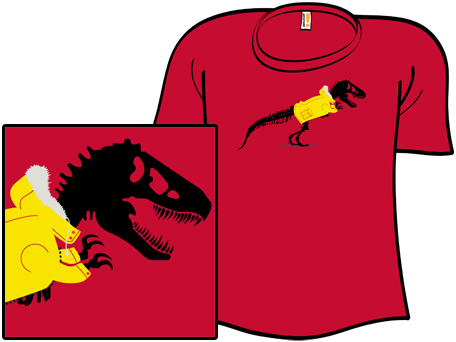
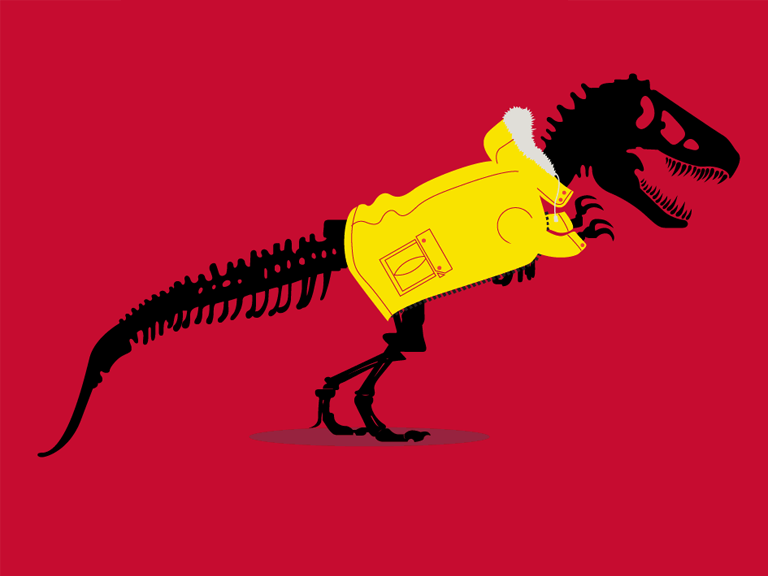 Get yours today for the low price of only $10!! Not sure how long they last on this site...
Hat tip to Brad!
© ReBecca K. Hunt-Foster
Get yours today for the low price of only $10!! Not sure how long they last on this site...Hat tip to Brad!
© ReBecca K. Hunt-Foster
Monday, January 4, 2010
Where did it get that name?
Every now and then (especially at work) I am asked:
All interesting questions!
The US Geological Survey maintains a great resource online - the GEOLEX, or "Geologic Names Lexicon." You can use this site to search for the answers to questions like the ones above, and many other things! It is a great resource I utilized when working on paleontological resource reports for the National Park Service over the past four years.
There have been two of these questions recently brought up on the Dinosaur Mailing List (or DML). The first asked about the origins of the Late Jurassic Morrison Formation:
Great question!
Dr. Tom Holtz gives a great explanation:
Another great question was asked the next day:
This one was easy for me, as Dewey Bridge is less than an hour from my house and I drive by it often when I go to Moab, Utah. It is off Highway 128 and crosses the Colorado River.
View Larger Map
So I went to the GEOLEX website to see when it was named and to see if it was indeed named for this particular bridge. The entry reads:
There is a Grand County, Colorado, but I am not familiar with a Dewey Bridge there. Oddly enough, the Dewey Bridge in Utah is also in Grand County, which got me to thinking there might be a mistake. So I went back to the USGS, this time looking at their Map Locator tool in the store area. I typed "Dewey Bridge" into the search box provided and *bam!* it takes me to Grand County, Utah. Not yet fully convinced, I click on the Dewey Quadrangle the locator found and download the quad. When I zoom into the Dewey Bridge area (see picture below), sure enough, the locality information given by the USGS matches. So I think, in this one small case, there is a tiny, but easily fixed and figured out, mistake on the USGS page.

Another way I could have done it was just to look for the Entrada Formation on the geologic map of Colorado in Grand County, but the only Jurassic I saw there upon quick look is Morrison Formation. I know from personal observation that the Entrada Formation is present in the Dewey Bridge area of Grand County, Utah. While the USGS recognizes the Dewey Bridge as the oldest member of the Entrada Formation in this area, the Utah Geological Survey includes it in the underlying Carmel Formation (it seems to vary between the two depending on you you talk to).
 Picture from the Grand County, Utah webpage, photo Courtesy of Rim Rock Road Runners
Some fun info about Dewey Bridge (pictured above) - it was built in 1916 and at that time connected this then remote portion of Utah with Grand Junction, Colorado, the areas largest city. It was listed on the National Register of Historic Places and was also the longest suspension bridge in Utah until its destruction. On April 6, 2008, a six year old boy who was playing with matches at a nearby campground accidentally set the bridge, and surrounding area, on fire (read the full account here). The county is now in the process of raising funds to restore the bridge [link to more information].
 Picture from the Grand County, Utah webpage, of the April 6, 2008, fire at Dewey Bridge.
 A picture I took this summer (August 25, 2009) of what is left of Dewey Bridge with the Entrada Sandstone in the background.
I hope these two tools, the USGS map locator and GEOLEX, are either something you already knew about and get use from or will help you to answer your own geologic questions someday!
Post and images © ReBecca K. Hunt-Foster, unless otherwise stated. Thanks to Tom Holtz and Donna for permission to use their quotes.
"Why is a formation named that?"
"How did that formation get its name?"
"Is that [town/landmark/place] named for the formation?"
"Where is the original [or type] location for that formation?"
All interesting questions!
The US Geological Survey maintains a great resource online - the GEOLEX, or "Geologic Names Lexicon." You can use this site to search for the answers to questions like the ones above, and many other things! It is a great resource I utilized when working on paleontological resource reports for the National Park Service over the past four years.
There have been two of these questions recently brought up on the Dinosaur Mailing List (or DML). The first asked about the origins of the Late Jurassic Morrison Formation:
"When was the Morrison Formation named? It was named after the town and not vice versa, right?" [link]
Great question!
Dr. Tom Holtz gives a great explanation:
"Yes, the Formation is named after the town. Standard stratigraphic practice is to name a formation or other lithostratigraphic unit after a geographic locality (typically a town) near the stratotype section (the lithostratigraphic equivalent to a holotype specimen)." [DML link][USGS link]
Another great question was asked the next day:
Does anyone know how the Dewey Bridge Formation got its name (was there an actual bridge? where? when was it named?)? [link]
This one was easy for me, as Dewey Bridge is less than an hour from my house and I drive by it often when I go to Moab, Utah. It is off Highway 128 and crosses the Colorado River.
View Larger Map
So I went to the GEOLEX website to see when it was named and to see if it was indeed named for this particular bridge. The entry reads:
"Usage: Dewey Bridge Member of Entrada Sandstone (CO*,UT*)...Type section: measured near Dewey Bridge, near center of sec. 8, T. 23 S., R. 24 E., Grand Co., CO (Wright and others, 1962)." [link]
There is a Grand County, Colorado, but I am not familiar with a Dewey Bridge there. Oddly enough, the Dewey Bridge in Utah is also in Grand County, which got me to thinking there might be a mistake. So I went back to the USGS, this time looking at their Map Locator tool in the store area. I typed "Dewey Bridge" into the search box provided and *bam!* it takes me to Grand County, Utah. Not yet fully convinced, I click on the Dewey Quadrangle the locator found and download the quad. When I zoom into the Dewey Bridge area (see picture below), sure enough, the locality information given by the USGS matches. So I think, in this one small case, there is a tiny, but easily fixed and figured out, mistake on the USGS page.

Another way I could have done it was just to look for the Entrada Formation on the geologic map of Colorado in Grand County, but the only Jurassic I saw there upon quick look is Morrison Formation. I know from personal observation that the Entrada Formation is present in the Dewey Bridge area of Grand County, Utah. While the USGS recognizes the Dewey Bridge as the oldest member of the Entrada Formation in this area, the Utah Geological Survey includes it in the underlying Carmel Formation (it seems to vary between the two depending on you you talk to).
Picture from the Grand County, Utah webpage, photo Courtesy of Rim Rock Road RunnersSome fun info about Dewey Bridge (pictured above) - it was built in 1916 and at that time connected this then remote portion of Utah with Grand Junction, Colorado, the areas largest city. It was listed on the National Register of Historic Places and was also the longest suspension bridge in Utah until its destruction. On April 6, 2008, a six year old boy who was playing with matches at a nearby campground accidentally set the bridge, and surrounding area, on fire (read the full account here). The county is now in the process of raising funds to restore the bridge [link to more information].
Picture from the Grand County, Utah webpage, of the April 6, 2008, fire at Dewey Bridge. A picture I took this summer (August 25, 2009) of what is left of Dewey Bridge with the Entrada Sandstone in the background.
 I hope these two tools, the USGS map locator and GEOLEX, are either something you already knew about and get use from or will help you to answer your own geologic questions someday!
Post and images © ReBecca K. Hunt-Foster, unless otherwise stated. Thanks to Tom Holtz and Donna for permission to use their quotes.
Sunday, January 3, 2010
The Secret Language of Elephants
This is a really interesting piece that aired tonight on 60 Minutes. Thinking about how elephants communicate started a whole thought process in my head on how other large herbivores (prehistoric in my mind) may have communicated. There are also a few long shots of the elephants at a watering hole that made me wonder if sauropods, for example, would of had large trails leading to and from water sources. Fun to think what it would have been like in the late Jurassic :)
Watch CBS News Videos Online
Watch CBS News Videos Online
Wednesday, December 30, 2009
Why do Geologist Love Beer?
Just in case you missed this article from Wired.com, a report from AGU on beer consumption. I am sure those of us who also attend GSA and/or SVP can relate.
Thanks to Pete and Stephanie for the link!
Thanks to Pete and Stephanie for the link!
Sunday, December 27, 2009
Season's Greetings
Season's Greetings!!
Check out this video of an ice skating sauropod via the Denver Museum of Nature and Science!

Thanks to Jerry Harris for the heads up!!
Saturday, December 19, 2009
Last minute Christmas gift?
 Are you still looking for the last minute Christmas gift for the paleontologist you love - or even something to suggest for yourself? Think Geek saves the day again with Evolvems! They have Coelacanth-Ichthyostega, Dimetrodon-Cynognathus, Pakicetus-Squalodon and my favorite Yinlong-Styracosaurus! How much fun would it be to open one of these on Christmas day and be able to unzip and flip the creatures inside out over and over and over again!
I hope everyone has a very wonderful Christmas!

Thursday, December 17, 2009
Clash of the Dinosaurs: Another dino disaster strikes a tv near you
The disaster that is the Dinosaur "Documentary" has struck again, this time in the form of Clash of the Dinosaurs. Last year it was Jurassic Fight Club, which there are very very very few good things that can be said for it. This years CotD, which premiered a few weeks ago (of which I have only see two episodes of), is not so impressive. Quite of bit of arm waving is once again presented as fact, and while a few good pieces of information made it though (Tom Holtz is wonderful as always, and his high energy and enthusiasm drips from the screen. Kudos Tom!), over all it has been graphics that are obnoxiously repeated over and over, with talking heads who have poorly labeled affiliations and even misspelled names (so I am nit-picky, shoot me). Maybe I am a traditionalist, but I miss the former documentaries that showed more of the process, and paleontologist actually working, not just appearing as talking heads. I am all for science based learning and documentaries to help convey the ideas to a wider audience, but not at the cost of science for entertainment.
But the most horrendous fault (currently) is the way fellow paleoblogger Matt Wedel's interview regarding the thought that sacral enlargements are "second brains." He has well documented this in post Here and Here which I strongly encourage you to read. Matt's original answer to this question was cut down to:
Yaaaaaaaaaaaa..... that is not what he originally said. It was cut down the the above statement, which is a far cry from his original statement of [from here]:
So basically they took his words, and completely misquote him and then do not apologize in follow up communication.
This is bullshit. These producers who are making these so-called documentaries need to do their job and convey truth and facts, not arm waving and pretty looking assumptions. These documentaries should be based on science, not pretty graphics and brief moments of facts presented. So, how can you help Matt in his quest to clear his name? He ask the following:
[update: while writing this post Matt posted the following - "Great news! I just got off the phone with someone at the Discovery Channel. He asked not to be named, but he has responsibility for Clash of the Dinosaurs and the authority to do what he promised, which is to fix the “second brain” segment exactly as I asked in the previous post! He said that the program would not be broadcast again until that segment was fixed, and that the fixed version would be in the DVD/Blu-ray release." Read his entire post here.]
Feel free to read other views on the subject:
The Medium & The Message (Prerogative of Harlots)
CotD: The Saga Continues (DinoGoss)
Dangerous Ltd. is Either Very Stupid or Dishonest, or Both (When Pigs Fly Returns)
I Swear I Didn't Say That! Having someone else put your foot in your mouth for you (Chinleana)
The media, again. This time distorting dinosaurs up front. (David Hone's Archosaur Musings)
A scientist is QUOTE MINED on a Discovery dinosaur documentary (Tetrapod Zoology)
© ReBecca K. Hunt-Foster
But the most horrendous fault (currently) is the way fellow paleoblogger Matt Wedel's interview regarding the thought that sacral enlargements are "second brains." He has well documented this in post Here and Here which I strongly encourage you to read. Matt's original answer to this question was cut down to:
"One of the curious things about Sauropods is that they did have a swelling in the spinal cord, in the neighborhood of their pelvis. This was sort of like a second brain to help control the back half of the body."
Yaaaaaaaaaaaa..... that is not what he originally said. It was cut down the the above statement, which is a far cry from his original statement of [from here]:
"Ok one of the curious things about saurapods is that they did have a swelling in the spinal chord in the neighbourhood of their pelvis. And for a while it was thought that may be this was sort of like a second brain to help control the back half of the body. Erm there are a couple of misconceptions there. One is that most animals control large part of their body with their spinal chord. If you’re going through day to day operations like just walking down the street and your minds on something else your brain isn’t even involved in very much controlling your body. A lot of that is a reflex arc that’s controlled by your spinal chord.
[From Matt] Quick aside: the technical term I was groping for here is not “reflex arc” but “central pattern generator”.
So its not just dinosaurs that are controlling their body with their spinal chord its all animals. Now the other thing about this swelling at the base of the tail is we find the same thing in birds and its called the glycogen body. It’s a big swelling in the spinal chord that has glycogen which is this very energy rich compound that animals use to store energy. Problem is we don’t even know what birds are doing with their glycogen bodies. Er the function is mysterious – we don’t know if the glycogen is supporting their nervous system – if its there to be mobilised help dry [should be 'drive' -ed.] their hind limbs or the back half of their body and until we find out what birds are doing with theirs we have very little hope of knowing what dinosaurs were doing with their glycogen bodies."
So basically they took his words, and completely misquote him and then do not apologize in follow up communication.
This is bullshit. These producers who are making these so-called documentaries need to do their job and convey truth and facts, not arm waving and pretty looking assumptions. These documentaries should be based on science, not pretty graphics and brief moments of facts presented. So, how can you help Matt in his quest to clear his name? He ask the following:
"You, reading this post: you are the audience. If you disagree with the idea that Dangerous Ltd has to subvert the truth to hold your attention, or if you’d like to support my request that they fix the show by removing the dishonestly edited portion, please contact them here. I shouldn’t have to say it, but this is the net, so: if you do contact them about this, please be brief, stick to the facts, and don’t be abusive, threatening or profane.
I’ve already e-mailed all of the top officers of Dangerous Ltd and this non-apology ... is the closest to an official response that I’ve gotten or expect to get. It might also be worthwhile to contact Zodiak Entertainment, the parent company of Dangerous Ltd, and make sure that they are aware of how their subsidiary is representing them. You may do so here; the previous plea for brevity and moderation applies.
Finally, outfits like Dangerous Ltd will only be able to pull this kind of crap for as long as Discovery Communications lets them get away with it. The most relevant thing I’ve been able to find for them is the Viewer Relations contact page for Discovery.com, which is here. Please let them know how you feel–briefly and politely, as always."
[update: while writing this post Matt posted the following - "Great news! I just got off the phone with someone at the Discovery Channel. He asked not to be named, but he has responsibility for Clash of the Dinosaurs and the authority to do what he promised, which is to fix the “second brain” segment exactly as I asked in the previous post! He said that the program would not be broadcast again until that segment was fixed, and that the fixed version would be in the DVD/Blu-ray release." Read his entire post here.]
Feel free to read other views on the subject:
The Medium & The Message (Prerogative of Harlots)
CotD: The Saga Continues (DinoGoss)
Dangerous Ltd. is Either Very Stupid or Dishonest, or Both (When Pigs Fly Returns)
I Swear I Didn't Say That! Having someone else put your foot in your mouth for you (Chinleana)
The media, again. This time distorting dinosaurs up front. (David Hone's Archosaur Musings)
A scientist is QUOTE MINED on a Discovery dinosaur documentary (Tetrapod Zoology)
© ReBecca K. Hunt-Foster
Tuesday, December 1, 2009
Save The UBC Dinosaur Track Quarry, West Paterson, NJ
Some Early Jurassic (Passaic Formation) dinosaur and reptile tracks are in danger of being destroyed in New Jersey so that condos can be built on the location. This is a petition to help gain attention to their importance and and have them included in the existing Rifle Camp Park. Please feel free to read the petition text below. A link to the petition can be found at the bottom of this post. Please feel free to sign it and pass it on. ~ ReBecca
Large museums and universities have done research projects and collected at the quarry to add to their collections and preserve these fossils. Ironically most of the fossils from this quarry are in private hands and not in a museum for folks to enjoy. The quarry was once an active quarry for many years but now has been sold to a developer to create high end condos that overlook NYC.
The remaining fossils in the quarry will be forever lost if the developers are allowed to demolish the remaining section of the quarry to complete their development. No more fossils from this period will ever be able to be collected again as this is the only place in NJ that has fossils from this time period. Once this section is gone there will be no more science or fossils to be gained. There is one section of the quarry left next to Rifle Camp Park that is of scientific significance that is threatened to be lost forever due to the development of these condos.
Some of the best preserved dinosaur and reptile footprints have been found in this quarry which do not compare to any other locality from New Jersey. Dinosaur tracks and fossil trace fossils have been a very unique, rare, and are an important piece of our fossil history and deserves to be protected. The state of New Jersey has done very little to protect fossil localities compared to other states in the USA and that is why we need your help. Trace fossils are a very important part of the state of New Jersey's history just like Hadrosaurus foulki and deserve to be protected, preserved and enjoyed by future generations. Let's not make this just a memory like other fossil sites in Northern NJ.
Let's make it a preserved site forever. Time is running out and only a few months left till it is gone forever. Thanks."
Online petition - Save The UBC Dinosaur Track Quarry, West Paterson, NJ
Thanks to Rissa for the heads up on this!
Subscribe to:
Posts (Atom)