Tuesday, July 14, 2009

Concretionary fun

There was a recent article in the Colorado Springs Gazette about fellow paleoblogger Anthony and his adventures in concretion land. As anyone who has ever had the pleasure of identifying fossils for the public we all know for every real fossil someone brings in you usually get a barrel full of concretions that people also brought in. I have found that having separate concretion and fossil examples that you can show to the public helps them to understand what they have and why it is not a dinosaur egg/heart/eye, fish, plesiosaur paddle, turtle, ect......sometimes it is an easy mistake to make, especially when you do not see fossils on a daily basis. Some of these concretions can be pretty cool looking and are interesting rocks/minerals on their own (without needing to pretend to be a fossil). And there are usually some pretty interesting storied that accompany most concretions.

I thought I would share some of the fun items we have in our lab that have been brought in and donated over the years:

Not sure what someone thought this one could be.

A variety of "eggs and/or turtles"


"Its a ceratopsian horn!" - No, its not. Sadly.

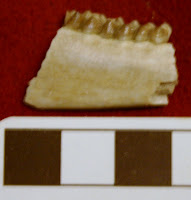
And this one is not a concretion, but I threw it in to see if anyone is paying attention. Any guesses on what it is (and there are at least two people out there who better know this):


© ReBecca K. Hunt-Foster

Friday, July 10, 2009

Fieldwork Friday #10

A few weeks ago we were working down in the Moab area, most unsuccessfully due to daily rainstorms, which made digging a bit difficult. So we had to bail on the quarry work for the most part and stuck to prospecting and checking out a few track sites in the area.

We prospected a section of Chinle Formation, where we found some wood (picture below) and isolated, indeterminate bone. Nothing to spectacular, unfortunately. And we, inevitably, got chased off by rain. A while down the road the rain blew out and we stopped to prospect a Paleozoic outcrop (I can’t remember the age, Penn. maybe). We found quite a few brachiopods, some crinoids and bryozoans - your typical invertebrate fun (I forgot to take pictures!).

We checked out quite a few track sites while we were over in the area, including the Poison Spider Mesa and Copper Ridge track sites (both in the Jurassic age Entrada Sandstone) that are managed by the BLM.

The tracks at Poison Spider Mesa are interesting because not only are they awesome tracks but also mudcracks, ripple marks and a ton of petroglyphs! These petroglyphs are from the Fremont culture. Some are really great and weird, and many of them have been vandalized by others who feel the need to leave their mark right next to these marks or some even modifying and marking over the petroglyphs. So sad and illegal!

Pictures from the Poison Spider Mesa Track Site:


Pictures from the Copper Ridge Track Site:


So, even though this is more of a paleosite visit trip than fieldwork, I thought I would include it in the series. Hope you enjoy it and have a chance to visit these sites some day!

© ReBecca K. Hunt-Foster. Please see the
"Field Work Friday Rules" about the work I do and collection practices.

Wednesday, July 8, 2009

A message from the Friends of the S. H. Knight Geological Museum

A statement from the Friends of the Friends of the S. H. Knight Geological Museum:

Statement from the Friends
On Tuesday, June 30 at 5:00 p.m. the University of Wyoming Geological Museum closed its doors. It was a sad moment for all of us who care about the museum. The museum was closed as a result of budget cuts announced by UW President Tom Buchanan on June 4, 2009 that included the museum’s small operating budget and the salary of the long-time director Brent Breithaupt and his part-time office assistant Jennifer Durer.

The outpouring of support for the museum from both the paleontological community and the general public has been overwhelming. Through on-line and paper petitions, Facebook and MySpace groups, blogs and emails, and newspaper articles and letter writing efforts, the President and Provost of the University of Wyoming as well as the Board of Trustees and the Governor are now very aware of the importance of the museum to the people and its role in research and in the education of everyone from children to college students to seniors.

Although the UW administration has not reversed the decision to close the museum, the overwhelming support shown for the museum has allowed the Department of Geology and Geophysics to begin to work with the administration to move towards new ideas for the permanent funding of the museum. These ideas include the establishment of an endowment that would fund the museum operations, including the salary of a director/curator. Obviously setting up and funding an endowment will take time and of course money, but we are hopeful that through these efforts the museum will re-open as a stronger and even more vital part of the Wyoming community.

We want to thank everyone for their support and hard work in helping us reach this point – it could not have been done without you! We will be continuing to gather support through this citizens group, the Friends of the S. H. Knight Geological Museum. There are links to the other on-line support activities on this blog, and we will keep it updated with the latest news about our efforts.

Now is the time to keep our efforts visible – we don’t want to lose this great momentum we’ve gained. If you signed the petition, now write a letter. If you’ve written letters, write more. And keep letting people know about our situation and how important the museum has been to you!

Again, thanks so much for all your support!

Tuesday, July 7, 2009

Who wants to go on a dinosaur dig?

Anthony over at the RMDRC paleo lab is looking for volunteers who are interested in going on a dinosaur dig in Montana at the end of the month. If you are interested read more of his post here.

© ReBecca K. Hunt-Foster

Monday, July 6, 2009

Carnegie Museum in the news


This article is making the rounds on the vertpaleo list server, and I thought I would post the link here in case you might have not seen it. It makes one point that is really sticking out in my mind:

"Funding agencies will not give money to an institution that isn't investing in its research," said Jody Martin, chief of the division of invertebrate studies at the Natural History Museum of Los Angeles County, which also is struggling to balance its staffing while balancing its budget. "If you're not serious, why should they give you money?"

Such a GREAT point!! I only wish more museums and administrations realized this! I can't count the number of times I have heard about someone leaving a position at a museum (or the museum loosing someone due to death, ect...) and the position never being filled, the position being filled but only temporarily, or the positions money being absorbed and used for other purposes. All of these things suck! In the Society of Vertebrate Paleontology there are over 500 student members right now. And all of these students (myself at one time) assume/think/hope that they are going to be able to get a job in typically a) an academic setting or b) a museum. If museums keep up this behavior of not filling positions what are all of these future paleontologist going to be doing with themselves...... (I hear Don Prothero addresses this in his newest book - Greenhouse of the Dinosaurs - which I have not had a chance to see yet, but I look forward to it!).

© ReBecca K. Hunt-Foster

Friday, July 3, 2009

Fieldwork Friday #9

Yesterday John and I had a chance to visit with Dr. Jim Kirkland (Utah State Paleontologist). Jim worked in Fruita in the 1990's as the lead paleontologist for Dinomations International Society, in the same building where Dinosaur Journey is currently located. He found and participated in many important paleontological discoveries in the western Colorado area during this time. These include a Dryosaurus nesting site in the Morrison Formation, a bird skull from the Green River Formation, the first Jurassic Ankylosaur - Mymoorapelta maysi (below), along with numerous other dinosaurs from the Morrison Mygatt-Moore Quarry.

While Jim was in town we took the opportunity to have him show us some of the classic sites he has worked, including the Dryosaurus nesting site. We hiked out the site and were happy to be able to find some additional bones.
(above) Jim and John at the site, (below) John and I at the site (picture by Jim Kirkland)

I was very excited to find a nice Dryosaurus coracoid, partial femur (pictured below) and two phalanges (toe bones). John found several small bone fragments and Jim found a nestling Dryosaurus vertebra (very small! I wish I had taken a picture of it).


Jim believes that this site was raided by mesosuchian crocodiles, which would eat the eggs/hatchlings and yearlings known from this site*. We also found a few pieces of egg shell at the site (pictured below).
This was only the second time I have seen egg shell in the Morrison Formation. The first time was at the Young Egg Site, also in Colorado (pictured below).


We continued on to prospect and locate another known site from the area (see below). We hope to be able to go out today to visit additional sites and have a chance to prospect some (if the rain will hold off).
Additional bone found in a Morrison Formation channel sandstone while prospecting.


* Kirkland, J. I. 1996. Predation of dinosaur nest by terrestrial crocodiles. Pages 124-133 in K. Carpenter, K. Hirsch, and J. Horner, editors. Dinosaur Eggs and Babies, Cambridge University Press. [free online here]

© ReBecca K. Hunt-Foster. Please see the "Field Work Friday Rules" about the work I do and collection practicies.

Thursday, July 2, 2009

How can I go on a Dinosaur dig?

This is one of many questions I get asked often (by non-paleontologist, typically). Below are a few non-commercial outfits that offer day digs and extended dig oportunities to the general public. All of the fossils collected on these digs go to museums and you have a chance to work along side paleontologist. If anyone else can think of others, please feel free to let me know.

Tuesday, June 30, 2009

A Very Sad Day

Today is a very sad day!! At the end of the business day the University of Wyoming Geological Museum will be closing its doors to the public and the two employees of the museum will loose their jobs. This amazing image pretty much sums up the last nearly 30 years of paleontology at the museum - a history which the University no longer finds important. A very very sad day for everyone.
(please click on image for a larger, better view)

A great article where we finally have a chance to hear how museum director Brent Breithaupt is taking all of this can be read here (a very emotional read). There is also a poor set of excuses and bad attempt to save face from the powers that be at UW here, and a word from the Governor of Wyoming supporting the cuts here. You might not like my description of these articles, but I am mad that this is happening and aggravated at the short-sightedness that the university administration obviously has. How can this museum not fulfill the universities core mission of teaching, research and outreach. It does ALL of these!

Please visit the "Keep Laramie Dinos" page for more information on what you can do to save this wonderful museum. An account has been set up to try and build an endowment to reopen the museum, hopefully in the very near future, as the S.H. Knight Geological Museum. Stay tuned for further developments as they occur.

© ReBecca K. Hunt-Foster, art © Anton Wroblewski

Monday, June 29, 2009

Museum Monday #1: St. George Dinosaur Discovery Site at Johnson Farm


I know I have fallen behind a bit with my "Fieldwork Friday" series. Sorry about that. It is not for a lack of field work, but more from an abundance of it and a lack of time to write about it. So, just to give me something else interesting to do, I thought I would write about some of the museums I have visited, and start a "Museum Monday" series. Let me know if you like it (or hate it).

-----------------------------------------------------------------------------------------
I thought I would start with the St. George Dinosaur Discovery Site at Johnson Farm (St. George, Utah). This museum is a unique, world-class dinosaur track museum. The museum sits on land that was once privately owned by Dr. Sheldon Johnson, and the first tracks were located on February 26th, 2000 to prepare the land for commercial resale. The tracks are found in the lower part of the Whitmore Point Member of the Moenave Formation (Early Jurassic in age; 195-198 million year old). After the discovery of the tracks and the large amount of visitation and press the site recieved, the land was donated to the City of St. George.


I first visited the site in 2002 when there was nothing more than a pavillion over some of the tracks and a garden shed as the prep lab. Since that time they have built a truly wonderful museum, which was finished in April 2005! I had never visited a museum where they preserve the original bedding plane for everyone to see. It is really a sight to see! They have several track blocks around for guest to view on the southeast side of the museum, with the main track layer exposed along the north side of the building. A lab where fossils (such as the numerous fish they have also discovered) are cleaned and studied, is situated in the southwest corner for visitors to view and ask questions. They also have a cool gift shop full of some unique gifts, not the same crap you see in every other gift shop.

Upon preparing the in place outcrop prior to building the museum they discovered the first ever track of a dinosaur crouching with clear hand impressions [see the paper here] was discovered. This is another really cool aspect about the museum - their website has a publications section where they add links to all of the recent research being done. I wish more museums took the time to do this. The museum also leads local paleontology tours.


You can see my pictures from the museum here.
-------------------------------------------------------------------------------------------

The museum is run by paleontologist Andrew Milner. I took a moment to interview Andrew and ask him a little about his background and how he came to work at this great museum:

(RKHF) What is your background? How did you get into
paleontology?

(AM): Did my undergrad degree at Brock University in St. Catharines, Ontario with a major in Geology and minor in Biology. Worked two years with the Canadian Museum of Nature in Ottawa
and five seasons for the Royal Ontario Museum in Toronto at the Burgess Shale in British Columbia. I've been preparing fossils since the age of 12. My interest in paleo always got in the way of school. Things have always got in my way for graduate school, but experience goes a long way and I have a lot of it. I'll complete graduate school one of these days, even if I'm in my 90's!

(RKHF) How did you get into paleontology?

(AM): I was 6 years old and had just moved from England to Quebec. My aunt came to Canada for a visit, and she picked up a Middle Ordovician brachiopod fossil off the trail and showed it to me. I was
collecting them for the rest of the hike. We lived in the Laurentian Mountains north of Montreal, so no fossils are known in this part of the Canadian Shield. Turns out that the gravel we were finding fossils in was shipped in from Montreal in the St. Lawrence Lowlands. I started digging holes in the driveway (also gravel from Montreal). My brother gave me a book on prehistoric animals and that's when I saw my first dinosaur. I've been hooked ever since, especially with lots of encouragement from my parents. My future was sealed when I started collecting Late Pleistocene Champlain Sea fossils (as seen in picture) and showing them to Dr. Richard Harington at the Canadian Museum of Nature. He was impressed with what I was finding (seal skull, complete frog, rare fishes, insects, plants, etc.).


(RKHF) What brought you to Utah from Canada?

(AM): My wife, Lynn White, graduated with a PhD in Physiological Psychology at McGill University in Montreal in 1997. She immediately sent out her CV and job applications all over Canada and the United States. She was accepted at University of Wisconsin, University of Prince Edward Island, and Southern Utah University in Cedar City, Utah. As soon as Lynn said Utah, I said let's go! The paleo of Utah being the key factor for me. We drove from Montreal to Utah in a moving truck in August, 1997.


(RKHF) What has been your favorite part about your job in St. George?

(AM): I think my favorite part of the job is when we are excavating new sites. I don't know what it is about this area, but as soon as we start digging we usually make a significant discovery. Getting to work with and meet so many interesting people is an added bonus.


(RKHF) What is the most professionaly important/significant thing you have done while at the track museum?

(AM): Difficult to choose from because so much has gone on here in such a short period of time. I suppose I would have to list as number one, helping build a museum to preserve the site.
Significant discoveries would be the world's largest and best preserved collection of theropod dinosaur swim tracks ever found, and the discovery of one of only five crouching theropod dinosaur traces. Ours is the only one in the world with clear hand impressions.


A restoration of Early Jurassic environment preserved at the St. George Dinosaur Discovery Site at Johnson Farm, with the theropod Dilophosaurus wetherilli in bird-like resting pose, demonstrating the resting trace with hand impressions. Art by Heather Kyoht Luterman, image from here.

(RKHF) Can you tell us a little more about how the track site was found, and how work there has progressed till now?

(AM): Dr. Sheldon Johnson was leveling a hilltop on his property, preparing the land for commercial resale. He had taken most of the hill away when a large sandstone block rolled out of the back of his dump truck. He noticed a three-toed natural cast of a Eubrontes track. His first thought was that the dinosaur was still in the rock and its foot was sticking out. It wasn't until he continued flipping rocks over that he realized that they were in trackways, and he was looking at sandstone infills of the tracks. Two weeks after the discovery Jim Kirkland called Wade Miller, Alden Hamblin and myself to go and look at the site. This was before the public found out about it. We met the press on that day and that's when people started visiting the site in huge numbers.

The City of St. George became involved and put up a fence around the site. Volunteers began
giving tours and the city hired a volunteers coordinator. Martin Lockley, Jim Kirkland and other came to the site to start proper documentation. That's when the in place "Top Surface" tracksite was discovered (one site now covered by the museum) and we had to stop excavating the "Main Track Layer" (original surface discovered by Sheldon). This is also when we discovered the tail drag with the Eubrontes trackway which secured $0.5 million from the federal government toward a museum. I was hired on by the City in October, 2001.

Hard to believe, but in less than 5 years after the discovery, a museum was being built over the site. Unfortunately our building is not big enough to house everything we have collected and we desperately need another building. Most of the dinosaur swimtrack collection is outside under make-shift wooden boxes and they deteriorating despite our effort to try and preserve them.

(RKHF) Do you have a favorite fossil that you have found (anywhere in the world)?

(AM): That's tough making me pick just one ... can I pick my top
five? At the St. George Dinosaur Discovery Site at Johnson Farm it would have to be discovering all of the dinosaur swimtracks in place. We have now identified well over 3000 individual claw marks and we are no where near finished preparation of the blocks. Finding a complete Anomalocaris at the Burgess Shale was a rush. The 10,800 year old leopard frog with insect part in its gut was an exciting discovery, especially since I'd always said, "I'd love to find a Champlain Sea frog!" All alone, jumping around like a crazy person on a beach along the Ottawa River when I found a Harp Seal skull was fun. Aside from the dinosaur swimtracks though, I think the best find of my life was showing Jim Kirkland where "Andrew's Site" was in the Lower Cretaceous Cedar Mountain Formation (pictured above). It's produced a new species of iguanodont (adult and juvenile), a new Fruitachampsa-looking terrestrial crocodile, the skull of a fairly large, new mammal, the tail of a small dromaeosaur, and a partial Gastonia on a lower bed. Two small theropod caudals are what made me take notice in 2002. Jim returned in 2005 to discover bones coming out all over the hill.

-----------------------------------------------------------------------------

Hope you have enjoyed this first Museum Monday post!

© ReBecca K. Hunt-Foster

Friday, June 26, 2009

Fieldwork Friday #8

The last week of May I returned to Nebraska to work with friends in the Oligocene White River Badlands of Shalimar Ranch (my fourth year in a row). As I have mentioned before, during the summer, the Geology Department at Augustana College (where I worked last year) offers a 3-credit course entitled "Fossil Mammals of the Badlands." This 2-week course travels to the White River Badlands of South Dakota and Nebraska to learn about the paleontology and geology of the area. The group camps on the ranch, outside of Harrison, Nebraska, and collects fossils on this privately owned land. This trip has become a tradition, with the first trip in 1982. Sadly, this may have been our last year. The ranch is now fore sale. If you know of anyone with a few extra million dollars you might tell them to look it up. It is a beautiful place.

White River Badlands on Shalimar Ranch


The weather was great when I arrived on the ranch! My first day in the field I had a chance to work with one of the students to remove a beautiful Oreodont skull and arm. This student, one of the geology department majors (we often have non geology majors on the trip) did the right thing. He found a skull and instead of trying to excavate it on his own, he came and found one of the instructors so we could show him how to properly excavate the specimen. I wish I had taken more pictures of the entire process, but here is a picture of the skull before we removed it.

Oreodont skull


I did not find too much this year. Many [fossil] turtles (tons of turtles in this area), occasional disarticulated mammal postcrania, and quite a few dentaries and isolated teeth (some pictures below of some of the random things I collected). The stuff I collected last year was pretty cool [picture].

The ranch has received a higher than usual amount of rain this past year and there were quite a few horney toads out and even a few frogs! Only one rattlesnake was spotted this year.


Horney toad!


Due to all the moisture there were some great mudcracks in the flats (see my new blog background). I got caught up in photographing them which was great when last week I had a chance to see a Jurassic example of curled mudcracks, very similar to what I saw in the field while on the ranch.
Mudcracks


Unfortunately, after two full days in the field we got rained out. It rained more in Harrison in one day than it had in the past 9 years (according to the local bar talk). It soaked everything. Several of the students tents quickly became small swimming pools, and I located a new hole in my tent rainfly. And of course it was located directly above my sleeping bag (lucky for me I have a waterproof bag!). Some quick improvising led me to use a car window sun shade to deflect the drips until I could get home and buy a patch. What did I learn from this (and another large hole I found in the tent itself) - never loan your tent out.

During a brief stop in the rain


The rest of the trip was spent visiting the Black Hills, Agate Fossils Beds National Monument, and Fort Robinson State Park, generally dodging the rain. It was a great trip. I hope we get a chance to return to the ranch next year!

At the Trailside Museum at Fort Robinson State Park


At Agate Fossils Beds National Monument

© ReBecca K. Hunt-Foster. Please see the "Field Work Friday Rules" about the work I do and collection practicies.