Thursday, December 2, 2021

Remembering Dr. Leo Carson Davis


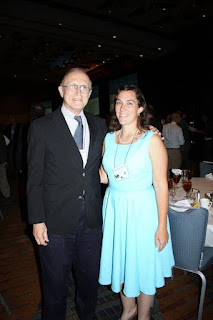
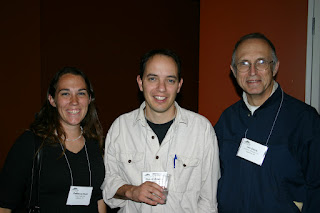
Dr. Carson Davis at the 2004 Society of Vertebrate Paleontology meeting with ReBecca Hunt-Foster and Blaine Shubert, at the time we were the only three vertebrate paleontologist in the state of Arkansas!

I met Dr. Davis in person around the summer of 1994. I was 15 years old and had an interest in vertebrate paleontology. His name had been passed on to me as the ONLY Member of the Society of Vertebrate Paleontology living in Arkansas around 1993. I wrote him a letter, and he wrote back, and we became pen pals. It was great fun for me to have someone to talk to pre-email, and he would send me postcards and letters from all his adventures, journal articles, newspaper clippings, and book about VP science making the news, and occasionally would send invertebrate fossils to identify, which I would mail back, and he would let me know how I was doing.  The summer of 1994 he invited my mom, sister, and I up to Peccary Cave to help excavate for an afternoon (I also met Ken Ball at this dig). It was great fun, and I remember climbing over a pile of guano in the cave, trying to not bump the sleeping bats on the roof, in order to get to the pit where he was digging. As a kid, this pit looked deep! It was a dark shaft with a ladder, which I climbed down. An auto light was lowered down so I could see, and the ladder was pulled out of the pit. They would lower a bucket on a string which I would fill with sediment that we later would screen wash for fossils by the nearby creek. This was my first fossil excavation experience, and it was very memorable and fun!

When I was in college at the University of Arkansas, he was my sponsor to the Society of Vertebrate Paleontology, which I joined in 2000. Dr. Davis helped me with my undergraduate senior thesis on Arkansaurus fridayi, and was my mentor for the 2003 Arkansas Undergraduate Research Conference Annual Meeting where I first presented on these fossils. He had introduced me to Mr. Joe Friday who discovered the fossils and met me in the field to show me where they had been discovered and for some prospecting. We kept in touch as I left for grad school, and as I moved around to my various jobs over the years, always sending letters and postcards, which I still cherish. We would occasionally see each other at Society of Vertebrate Paleontology meetings, and it was always great to catch up. Without his early encouragement and mentorship, I know I would not be where I am now in my career. His kindness has left a mark on me, and I remember it every time I receive a letter from a kid who also loves fossils, and I make sure to write them back and continue to pass on the mentorship and support that I received from Dr. Davis. I owe him so much and very much appreciate the time he took on an enthusiastic Arkansas kid who had fallen in love with fossils. He helped open up the world of paleontology for me, and his support and friendship has meant the world to me over these years. I will always remember him fondly and continue to pass down the mentorship he shared with me to our next generation of young scientists.     

Obituary: https://www.arkansasonline.com/obituaries/2021/nov/28/leo-davis-2021-11-28/

Memory Wall: https://www.lewisfuneralhome.biz/obituaries/Leo-Davis-6/
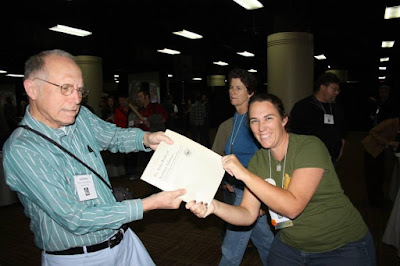

2013 Society of Vertebrate Paleontology meeting "fighting" over a USGS monograph on the Paleozoic of Arkansas

2012 Society of Vertebrate Paleontology meeting 


© ReBecca K. Hunt-Foster

Thursday, November 15, 2012

The Philip J. Currie Dinosaur Museum project has gone global!

Dusting off the old blog to help out a good cause. Below is a message from the good folks at Pipestone Creek Dinosaur Initiative (PCDI). They have started a crowd-funding campaign in order to raise money to build the The Philip J. Currie Dinosaur Museum. Please read their press release below and think of contributing!

Hope everyone is well out there! ~ ReBecca

$1,000,000 in 120 Days 

The PCDI launches a crowd-funding campaign on Friday


Bring in the crowds! This Friday, Oct. 12, the Pipestone Creek Dinosaur Initiative (PCDI) is launching a crowd-funding campaign to help build the Philip J. Currie Dinosaur Museum. Hosted by Indiegogo.com, the Initiative is aiming to raise $1,000,000 in 120 days.

For those not familiar with crowd-funding, this is a relatively new, fun and fast-paced way to raise funds online for projects of any size and scope.

 The premise is simple. The site gives projects space to create an online profile outlining their mission. Would-be donors can go online to read about the project, explore the positive impacts it will have, check out a photo gallery, watch videos and generally decide if they’re interested in contributing to its success. Donors can then donate online, through a secure credit card payment or Paypal ™, similar to online shopping.

The Initiative’s campaign launches this Friday at Indiegogo.com/curriemuseum.

 Donations start at a minimum $10 and can be any amount thereafter. Gifts called ‘perks’ are provided according to the size of donation. These range from a museum pin all the way up to a naming opportunity on a room or gallery in the museum. Other perks include a limited edition print by acclaimed palaeo-artist Julius Csotonyi and an autographed book by Dr. Philip Currie. The entire list of perks is available at the online campaign profile.

“This campaign already has a lot of excitement surrounding it. We’re urging all community members to go and donate,” said PCDI executive director Brian Brake, “Every bit makes a difference when it’s a crowd.”

Indiegogo.com is a well-respected crowd-funding host site. Some may recall the story of Karen Klein, the bus monitor in Greece, New York who was videoed this past July as she was verbally harassed by some youth on a bus. After the video was made public, a Good Samaritan created a profile for Klein on Indiegogo.com to raise money to give her a vacation. For a $5,000 goal, over $720,000 was raised.

 “One of the most important things is to spread this around the world,” said Brake. “We’re asking everyone to put it on their Facebook and Twitter accounts and email it out to their entire contact list. We have 120 days to hit our goal; we need people to move quickly.”

The Philip J. Currie Museum currently has $17.4 million raised of $30 million. A sponsorship program engaging the local municipalities to bring that figure up to $27.4 million is currently underway. To complete the funding, a naming opportunities sponsorship program is also in progress, offering significant donors the chance to have their name affixed to a room, display or area in the museum. The projected timeline for the museum’s creation includes going to tender in January 2013, breaking ground in April 2013 and hosting a grand opening in June 2014.

Don’t forget to view the campaign profile at Indiegogo.com/curriemuseum!


About the Philip J. Currie Dinosaur Museum
and Pipestone Creek Dinosaur Initiative

The Philip J. Currie Dinosaur Museum will preserve and display the unique fossils of northwestern 
Alberta and serve as a regional centre of excellence for tourism, science, heritage preservation and 
education. Major outcomes of the proposed cultural and scientific institution include enhanced economic 
and cultural development and increased knowledge of the Cretaceous geology that forms the bedrock of 
Alberta’s oil and gas industry. The museum, with a footprint of 41,000 square feet, will be located on a 
10-acre site in the Town of Wembley, Alberta, on the highway to Alaska. The facility will have a 
significant positive impact on the local area’s learning opportunities in the fields of culture, heritage and 
science through its interactive displays, resident experts and curriculum-based educational programs. 
The museum will house two classrooms, a 64-seat theatre, restaurant with drive-thru service, gift shop, 
boardroom, tourism visitor services, 12,000 square feet of interactive and interpretive displays, a scientific 
laboratory, fossil curatorial space and a 120-vehicle parking lot. The Pipestone Creek Dinosaur Initiative 
is the omnibus term for the project team tasked with the realization of the museum.


For more information please contact:
Erika Sherk
PCDI Communications and Marketing Manager
phone: (780) 532-2362 x. 5
mobile: (780) 512-6113
email: esherk@countygp.ab.ca
web: curriemuseum.ca
 

© ReBecca K. Hunt-Foster

Thursday, March 22, 2012

Summer Field Paleontologist needed

Job Title:  Summer Field Paleontologist


Location: Standing Rock Indian Reservation ND/SD

Job Description:  The Standing Rock Indian Reservation is one of the largest reservations in the United States and the only Tribe with a Paleontology Department.  Under the direction of the Tribal Paleontologist - consultants, students and volunteers assist in fieldwork in the fossil-rich badlands of South Dakota.  The Standing Rock Paleontology Department is searching for a Field Paleontologist to assist the Tribal Paleontologist during the 2012 Field Season (June to August) in the collection of and exploration for fossils.     

The Field Paleontologist is responsible for assisting the Tribal Paleontologist in managing the field staff and ensuring that the field paleontology program operates efficiently.  The incumbent will be expected to supervise several field assistants and/or volunteers of varying skill and knowledge levels, know and teach various field paleontology methods and techniques, and be able to keep good field notes and documentation of fossil localities.  During times of inclement weather, work will be temporarily moved to the Paleontology Lab in Fort Yates, ND where the incumbent will assist in regular lab work including, fossil preparation and molding and casting.

Duties and Responsibilities:
  1. Lead/supervise teams of two or more Field Assistants and/or volunteers in the prospecting for and excavation of fossils.
  2. Properly document fossil localities, geologic and stratigraphic information and fossil collection.
  3. Will take an active role in fossil prospecting, collection and excavation.
  4. Reports to the Field Paleontology Supervisor(s) on a daily basis.  
  5. Assists the Field Paleontology Supervisor(s) in managing the field crew and camp maintenance.  
  6. Responsible for helping with field camp maintenance including but not limited to mowing grass, organizing tools and equipment, cleaning vehicles and ensuring that the camp is kept tidy and in good working order.
  7. Assist in fossil preparation, molding and casting.
  8. Assist in fossil identification and cataloging.
  9. Will help to train new Field Assistants and teach proper field methods and techniques to Field Assistants and volunteers.
  10. Ensure compliance of Field Assistants and volunteers with departmental policies and regulations.

 Qualifications:
  1. Master’s degree in paleontology preferred; Bachelor’s degree in geology or related field with field work experience acceptable.
  2. Must have knowledge of geological and paleontological concepts, methods and techniques.
  3. Must have paleontology field work experience.
  4. Must be able to lift heavy loads and work under adverse conditions typical for the  badlands of South Dakota.
  5. Must possess a valid driver’s license and be able to provide own transportation to and from the field camp.
Applicants must have a Master’s degree in paleontology (preferred) or Bachelor’s degree in geology or related field with paleontology field work experience.  Must have knowledge of geological and paleontological concepts, methods and techniques.  Must be able to lift heavy loads and work under adverse conditions typical for the badlands of South Dakota.  Must possess a valid driver’s license and be able to provide own transportation to and from the field camp.  Salary commensurate with experience.

To apply, please send a resume, fieldwork experience and references via email or mail. Direct questions to Standing Rock Sioux Tribe Paleontology Department 701-854-8648 or 701 854-8649.  Open until filled.

Send applications to:A. R. Shaw or A. Swallow Standing Rock Paleontology DepartmentPO Box DFort Yates, ND 58538

ashaw@standingrock.orgaswallow@standingrock.org

Saturday, March 3, 2012

Got Geologic maps?

I am interested in obtaining some used/torn/brittle/old/new/or no-longer-needed geologic maps (or even topos). Does anyone have any they would like to get rid of or see given a second life? Something gathering dust in your lab or shoved in a corner? Just leave me a comment here or send me an email. Thanks! 


© ReBecca K. Hunt-Foste


Friday, February 17, 2012

Variation in the skull of Anchiceratops, a horned dinosaur from the Horseshoe Canyon Formation

Enjoy this video by my friend Jordan on is work with Anchiceratops:


 Thanks to Tom H. for the heads up!

  © ReBecca K. Hunt-Foster

Thursday, February 9, 2012

Tuesday, January 10, 2012

Happy Steno Day

I hope everyone had a good day and remembered to celebrate the 374th birthday of Nicolas Steno. Google celebrated his birthday with a good doodle:


Thanks to Steve for the heads up on the doodle. © ReBecca K. Hunt-Foster

Sunday, December 25, 2011

Merry Christmas everyone!

Happy birthday to Jimmy Buffett as well. Hope everyone has a great Christmas!


Thanks to T. Holz for the heads up on this gem! 


© ReBecca K. Hunt-Foster

Sunday, December 18, 2011

Thursday, December 1, 2011

Job openings: internships, summer field work and even a few "real" jobs

For all those students and recent graduates who are going to be looking for work this summer, now is the time to start paying attention (there are even a few "real" jobs showing up). Jobs and internships have started to be advertised and are often popping up until around February/March, so keep your eyes peeled. Check the SVP jobs page for updates as well.

Here are a few that are currently open:

2012 GeoCorp Positions (applications due by February 1, 2012) -


Petrified Forest National Park
Petrified Forest National Park in northeastern Arizona currently has a position open for a GS-7 Physical Science Technician. This is a full-time seasonal position that will start in May of 2012 and continuing through August of 2012 (dates are flexible for students). This position will be the lead for a field based program working in exposures of the Upper Triassic Chinle Formation, including intensive prospecting as well as excavation of vertebrate fossils from existing quarries.  As the lead this person will oversee all aspects of field work including daily supervision of student interns. This position will work closely with the Park Paleontologist to successfully carryout and document this work. Interested applicants should have experience in the collection of vertebrate fossils, especially successful construction and removal of field jackets as well as the willingness/ability to supervise this type of work. This is a U. S. federal government position open to all U.S. citizens. The incumbent must possess a valid U. S. drivers license. This job also requires the successful completion of a background check as currently required for all U. S. Federal positions.

For more information and to apply please see the current job announcement at www.usajobs.gov
(http://www.usajobs.gov/GetJob/ViewDetails/303892400). Please review all details especially the section on "How to Apply".

The position will close on December 9, 2011.


The Wyoming Dinosaur Center 

The Wyoming Dinosaur Center is looking for undergraduate and graduate students interested in paleontology, biology, geology and education to help with summer programs. Responsibilities will include excavation of dinosaur quarries, tours, cleaning fossils in the prep lab, assist in the molding and casting lab, and participation in the Dig-for-a-Day and Kids Dig programs. No paleontology field experience is necessary but preferred. Preference will also be given to those with an interest in Morrison Fm. fauna and associated paleoenvironments in the Big Horn Basin. Housing is provided. Valid drivers license is required. Training will begin May 24th, please send resume. For more information contact Angie Guyon at angie@wyodino.org


"REAL" JOB ALERTS: 
  1. GS-7 Museum Technician (Fossil Preparator, permanent full time), Hagerman Fossil Beds National Monument: Primary duties will be preparation of Pliocene-aged mammals from the Hagerman Horse Quarry. This position closes December 9th and can be found on USAJOBS.
  2. Assistant or Associate Professor in Paleontology, South Dakota School of Mines and Technology -  The Department of Geology and Geological Engineering at South Dakota School of Mines and Technology invites applications for a nine-month tenure track position in paleontology at the Assistant or Associate Professor level. The successful applicant should have a robust background in analytical paleontology, such as geochemical applications in paleontology, and will teach courses and advise student research at the undergraduate and graduate level. He or she is expected to develop an externally funded research program that complements current departmental research strengths. The department offers BS, MS and Ph.D. degrees with emphases in geology or paleontology, including an MS in Paleontology. The Museum of Geology’s paleontology collections, consisting of 500,000+ specimens, are housed in the James E. Martin Paleontology Research Laboratory. A Ph.D. in geology or a closely related field is required at the time of appointment. Nine-month salary range will be commensurate with background and experience. Application deadline: February 1, 2012 [link]
  3. Vertebrate Paleontologist: Assistant or Associate Professor, Fort Hays State University - Fort Hays State University is seeking a Vertebrate Paleontologist at the Assistant or Associate Professor level (tenure track) beginning June 11, 2012. This position is a joint appointment between the Department of Geosciences (0.5 FTE) and the Sternberg Museum of Natural History (0.5 FTE). ...  Preference will be given to individuals with knowledge of vertebrate fossils from the Late Cretaceous or Late Cenozoic of the Great Plains....Application deadline: January 15, 2012 [link
  4. Earth Sciences Collection Manager, University of Alaska Museum - The Earth Science Department at the University of Alaska Museum in Fairbanks seeks a full time Collections Manager to help oversee its paleontological and geological collection. The Collections Manager’s responsibilities include the day-to-day care and organization of the collection, managing collections data using a computerized database (Arctos), specimen preparation and conservation, supervising students and volunteers, administering loans, and public contact. ... The minimum qualifications are a Master’s degree in a related field (paleontology, biology, geology, museum science) or equivalent training and experience. Preference is given to applicants who have are familiar with using a relational database, and have at least two years experience conducting fossil preparation. To view a full position description or apply for the job, go to: www.uakjobs.com/applicants/Central?quickFind=75729 Application deadline: December 15, 2011 [link]
Good luck to all the applicants! 


This position is classified as "Guest Scientist" positions. This position generally requires a higher level of qualifications and may involve a longer project and a higher stipend. Past GeoCorps participants can ONLY apply to Guest Scientist positions. Those who have not participated in GeoCorps before can also apply. To see details and eligibility requirements, please go to the About GeoCorps page.


** The following positions are part of the GeoCorps Diversity Internship Program and the GeoCorps American Indian Internship Program. To see details and eligibility requirements, please go to the GeoCorps Diversity Internship home page and the GeoCorps American Indian Internship home page.


© ReBecca K. Hunt-Foster

Sunday, October 16, 2011

BLM fun + job


And now you too can be part of all the BLM fun! A full-time Paleontologist job has been listed for the Billings, Montana office. You know you want to be humming the BLM rap while working in that office. Apply now

Thanks to Darrin P. for the heads up on the video. 

  © ReBecca K. Hunt-Foster

Wednesday, October 5, 2011

New Early Cretaceous Dinosaur Tracks from Southwestern Arkansas

Earlier this summer some new tracks, most notably sauropods and theropods, were found in southwestern Arkansas, in the same gypsum quarry where other tracks were located in the 1980's. Back then, Jeff Pittman had been doing some work at the quarry and often was displeased with the potholes he had to drive across every day. In late 1983 he and Dave Gillette confirmed that the "potholes" were actually thousands of sauropod tracks. The tracks were destroyed the next year. An account of that story can be found here.

Large theropod track in the Cedar Mountain Formation near Moab, Utah
The large theropod tracks at the Arkansas site look very similar to a new track series near Moab near the base of Ruby Ranch Member of Cedar Mountain Formation (picture right). This site is currently being developed into a protected interpreted trail by the BLM. Stay tuned for more information on this site as it becomes available. The site is being worked on by Brent Breithaupt (BLM regional paleontologist), Neffra Matthews (BLM), and Martin Lockley (CU Denver - retired). It should prove to be a very interesting site once it is described. Work is planned to compare this site to the Arkansas site. 

Working at the Cedar Mountain track site last summer, September 9, 2009
(l-r: Me, Scott Foss [BLM], Neffra Matthews & Brent Breithaupt)

The story below is the report from the University of Arkansas, my alma mater, who worked most recently on the Arkansas tracks. I was not involved in the work at this site. If you have any specific questions please direct them to Steve Boss

Large Field of Dinosaur Tracks Uncovered in Southwest Arkansas
High-tech and traditional techniques used to study footprints 
Wednesday, October 05, 2011 [link]


This July 12, 2011, photo provided by the University
of Arkansas shows tracks from a three-toed
dinosaur that researchers are studying
 in Southwest Arkansas. (AP Photo/
University of Arkansas, Russell Cothren)

FAYETTEVILLE, Ark. – The discovery of a large field of dinosaur tracks in Arkansas has researchers busy using cutting-edge technology and traditional techniques to learn all that they can about the animals and environment that existed there 120 million years ago.

The track site, found in southwest Arkansas, covers an area of about two football fields and contains the fossilized tracks of several species and tracks from multiple animals of the same species, some of which have never been previously documented in Arkansas. The site will help researchers learn not only about the creatures that once roamed through the area, but also about the climate during the Early Cretaceous period 115 to 120 million years ago.

“The quality of the tracks and the length of the trackways make this an important site,” said Stephen K. Boss, who led the National Science Foundation-funded project. Based on the rock in which the footprints were found, researchers have a good idea of what the climate would have been like.

“Picture an environment much like that of the shores of the Persian Gulf today. The air temperature was hot. The water was shallow and very salty,” Boss said. “It was a harsh environment. We’re not sure what the animals were doing here, but clearly they were here in some abundance.”

The most dramatic tracks found, those of a three-toed dinosaur, measure about two feet long by a foot wide. The researchers believe the footprints might belong to Acrocanthosaurus atokensis, one of the largest predators ever to walk the earth. The site also contains the giant prints of sauropods, large, long-necked plant-eating dinosaurs such as Pleurocoelus and Paluxysaurus. Other prints pepper the site as well, but it will take scientists some time to determine what other creatures might have walked through that area.

“Through tracks, we can learn all sorts things about dinosaur biomechanics and behavior,” said Brian Platt of the University of Kansas. “Dinosaur bones can be dragged away by animals or swept out to sea. But we know that about 120 million years ago, dinosaurs walked right through here.”

Thanks to a fast-track grant from the National Science Foundation, the University of Arkansas office of research and economic development and the J. William Fulbright College of Arts and Sciences, a team of researchers spent two weeks studying the site, which is on private property. In addition to chisels, hand-held brooms and plaster, some scientists brought along their computers. Jackson Cothren and Malcolm Williamson, researchers from the department of geosciences and the Center for Advanced Spatial Technologies at the university, documented the tracks using LiDAR, short for “light detection and ranging.” They used two different instruments to map the site.

First, they used a Z+F Imager 5006i mounted on a cherry picker. The imager is a phase-based scanner that emits a constant beam of laser light, which is swept across the landscape to measure and record up to 500,000 points per second.

The second unit, used to record an overview of the site from the ridge above, is a Leica ScanStation C10. This time-of-flight scanner incorporates discrete pulses of laser light at a rate of 50,000 per second, each recording a point in space. Depending on the path of a given laser pulse, up to four return pulses are recorded by the instrument's receiver. The location where each LiDAR return pulse originated is computed, allowing the researchers to study a three-dimensional “point cloud” representing the tracks.

By using LiDAR, the researchers will be able to view a highly accurate map of the site’s tracks and take detailed measurements of the height, width and depth of individual tracks as well as measurements of the trackways. These measurements will help them learn details about the animals’ identities, movements and behavior.

While computer imagery can give an overview of the dinosaurs, rock samples from the site can offer clues to climate.

“Because we see footprints here, we know that this surface was at one time exposed to the elements,” said Celina Suarez, a postdoctoral researcher at Boise State University who will be joining the faculty at the University of Arkansas in the fall of 2012. This exposure means that scientists can learn information about the frequency of rain and amount of evaporation that affected this site 120 million years ago. Using this site and others, they can reconstruct a regional paleoclimate during the Early Cretaceous period, which may help them make predictions about Earth’s future climate.

“This site will add to the knowledge of both the animals and climate of the Early Cretaceous,” Boss said. “Scientists will be studying these data for many years.”

Other researchers involved with the project include geosciences master’s candidate Terryl Daniels; senior geosciences major and Honors College student Alex Hamlin; junior geosciences major Ryan Shell; Joann Kvamme, coordinator for the environmental dynamics program; and Kenneth Kvamme, professor of anthropology, all at the University of Arkansas; and Greg Ludvigson of the Kansas Geological Survey.


© ReBecca K. Hunt-Foster, University of Arkansas story from here

Friday, July 1, 2011

Fruita Friday 8

Sadly this piece of art is no longer with us. It was originally painted on the back of a downtown building but was removed in ~2008(?).

Photos from "Roadside Dinosaurs/RoadsideArchitecture.com"


Former Location: 122 East Aspen Street, facing the Fruita Fitness Center. 

© ReBecca K. Hunt-Foster

Friday, June 24, 2011

Fruita Friday 7

Not really art, but how often can you stand on the corner of the Jurassic and the Cretaceous??


Location: Corner of Jurassic Avenue and Cretaceous Street, in front of the Comfort Inn and behind El Tapatio Restaurant.  

View Larger Map
© ReBecca K. Hunt-Foster

Barbie's take on Evolution

The Miss USA contestants were each asked if they thought evolution should be taught in school. I am surprised which states representatives were for it, and which states wanted "both sides" taught....Note that Miss California/Miss USA 2011 is in favor of evolution being taught in schools. 


Thanks to my aunt for the heads up! 


© ReBecca K. Hunt-Foster

Friday, June 17, 2011

Fruita Friday 6

Painting on the northeast side of a downtown Fruita building (artist unknown)


Location: The northeast corner of Mulberry and Aspen Streets. 

View Larger Map
© ReBecca K. Hunt-Foster

Monday, June 13, 2011

RIP Patti Kane-Vanni

After a long battle against cancer, we have lost one of our own ....

Artist

Explorer

Friend

Rest in Peace PaleoPatti

Services will be held at St Mathias Church in Bala Cynwyd at 11:00 AM on Wednesday.

Random Picture Monday


In Delta, Colorado

Friday, June 10, 2011

Fruita Friday 5

Grrrreta can be found in the Fruita City Circle. It was named by local school children in 2000 and she is decorated for Christmas with a giant Santa hat and the Grinch hanging out of her mouth. 


Location: Fruita Park Circle (see map below) 
View Larger Map
© ReBecca K. Hunt-Foster

Thursday, June 9, 2011

McInnis Canyons Mygatt-Moore Quarry Gives Up Fossil Clues

ResearchBlogging.org John and I have been continuing our research out at the Mygatt-Moore Quarry in western Colorado, and recently had a paper on one of our findings published in the Journal of Vertebrate Paleontology in May.

Foster, John R. and Hunt-Foster, Rebecca K.(2011) 'New occurrences of dinosaur skin of two types (Sauropoda? and Dinosauria indet.) from the Late Jurassic of North America (Mygatt-Moore Quarry, Morrison Formation)', Journal of Vertebrate Paleontology, 31: 3, 717 — 721 DOI: 10.1080/02724634.2011.55741

We work each summer at this quarry under a paleontological permit from the Bureau of Land Management, which is located in the McInnis Canyons National Conservation Area (NCA), near the Colorado/Utah state line. “The national significance of the area's paleontological resources is one of the many reasons this special place was designated as a National Conservation Area,” said Katie Stevens, NCA Manager for the BLM’s Grand Junction Field Office. “With experts like John and ReBecca working in these quarries, we can recover and share this exciting and important scientific information with the public.” John is currently working under a scientific grant from the BLM to better understand the extent of the quarry and the conditions that made it such an ideal location for preserving fossils [details].

The first specimen was located by Jim Kirkland and his expedition to the quarry in 1993 (MWC 1903). A expedition member, Dan Libecap, discovered the second specimen (MWC 5537) in 2003. Two of our museum volunteers, Kay Fredette and Ray Bley, uncovered the most recent specimen (MWC 6718) in 2008.

Two of the three specimens (MWC 6718 & 5537) are possibly from sauropods, and we attributed the third specimen to Dinosauria indeterminate (MWC 1993). The two possible sauropod specimens represent the first occurrence in the Morrison Formation of preserved sauropod skin associated with abundant nearby specimens of Apatosaurus. They also show how similar the general structure of skin patterns within known Morrison diplodocids are.

Specimen MWC 6718 - carbonized sauropod? skin impression from the Mygatt-Moore Quarry. Morrison Formation (Upper Jurassic) of Mesa County, Colorado. scale bar =5 cm

These discoveries were unique because the soft tissue associated with the skin was preserved as carbonaceous layers rather than as trace fossil impressions, yielding better information about skin pattern, scale size and scale shape. This discovery is is the sixth occurrence recovered from the Morrison Formation.

If you would like a PDF of this paper please contact me here or by email and I would be happy to share one with you. We plan for this paper to be the first of many that will be published over the next few years. Below is a complete bibliography of research from Mygatt-Moore Quarry that has been done to date (PDF's of select papers are also available):

Foster, John R. and Hunt-Foster, Rebecca K. (2011). New occurrences of dinosaur skin of two types (Sauropoda? and Dinosauria indet.) from the Late Jurassic of North America (Mygatt-Moore Quarry, Morrison Formation) Journal of Vertebrate Paleontology, 31 (3), 717-721 : 10.1080/02724634.2011.55741

Foster, John R. 2007. Jurassic West: The Dinosaurs of the Morrison Formation and Their World. Indian University Press, 416 pages.

Foster, John R; Hunt, ReBecca K; King, Lorin. 2007. Taphonomy of the Mygatt-Moore quarry, a large dinosaur bonebed in the Upper Jurassic Morrison Formation of western Colorado. Geological Society of America, 2007 annual meeting, Abstracts with Programs - Geological Society of America, vol. 39, no. 6, pp.400

King, Lorin R; Foster, John. 2006. Under the feet of giants; an investigation of the small vertebrates at the Mygatt-Moore Quarry, Morrison Formation, western Colorado. Sixty-sixth annual meeting, Society of Vertebrate Paleontology; abstracts of papers. Journal of Vertebrate Paleontology, vol.26, no.3, Suppl., pp.85

King, Lorin R; Foster, John R; Scheetz, Rodney D. 2006. New pterosaur specimens from the Morrison Formation and a summary of the Late Jurassic pterosaur record of the Rocky Mountain region. In (editors - Foster, John R; Lucas, Spencer G) Paleontology and geology of the Upper Jurassic Morrison Formation. Bulletin - New Mexico Museum of Natural History and Science, vol.36, pp.109-113

Foster, John. 2005. Evidence of size-classes and scavenging in the theropod Allosaurus fragilis at the Mygatt-Moore Quarry (Late Jurassic), Rabbit Valley, Colorado. Sixty-fifth annual meeting, Society of Vertebrate Paleontology; abstracts of papers. Journal of Vertebrate Paleontology, vol.25, no.3, Suppl., pp.59

King, Lorin; Foster, John; Scheetz, Rodney. 2005. Mesadactylus and other new pterosaur specimens from the Morrison Formation (Upper Jurassic) of western Colorado. Sixty-fifth annual meeting, Society of Vertebrate Paleontology; abstracts of papers. Journal of Vertebrate Paleontology, vol.25, no.3, Suppl., pp.78

Kirkland, James I. 1998. Morrison fishes. Modern Geology 22: 503-533

Tidwell, W.D., Britt, B.B., and Ash, S.R. 1998, Preliminary floral analysis of the Mygatt-Moore Quarry in the Jurassic Morrison Formation, west-central Colorado: Modern Geology 22: 341-378

Chin, K. and Kirkland, J.I. 1998. Probable herbivore coprolites from the Upper Jurassic Mygatt-Moore Quarry, Western Colorado. Modern Geology 23: 249-275.

Kirkland, J. and K. Carpenter. 1994. North America's first pre-Cretaceous ankylosaur (Dinosauria) from the Upper Jurassic Morrison Formation of Western Colorado. Brigham Young University Geology Studies, 40:25-42.

Kirkland, James I; Armstrong, Harley J. 1992. Taphonomy of the Mygatt-Moore Quarry, middle Brushy Basin Member, Morrison Formation (Upper Jurassic), western Colorado. Society of Vertebrate Paleontology, fifty-second annual meeting. Journal of Vertebrate Paleontology, vol. 12, no. 3, Suppl., pp.37A

Mygatt, Peter. 1991. The Mygatt-Moore Quarry, Rabbit Valley, Mesa County, Colorado. Pages 57-58 in (editor - Averett, Walter R.) Guidebook for dinosaur quarries and tracksite tour, western Colorado and eastern Utah. Grand Junction Geol. Soc., Grand Junction, CO